To The Victoria Falls
To the Congo
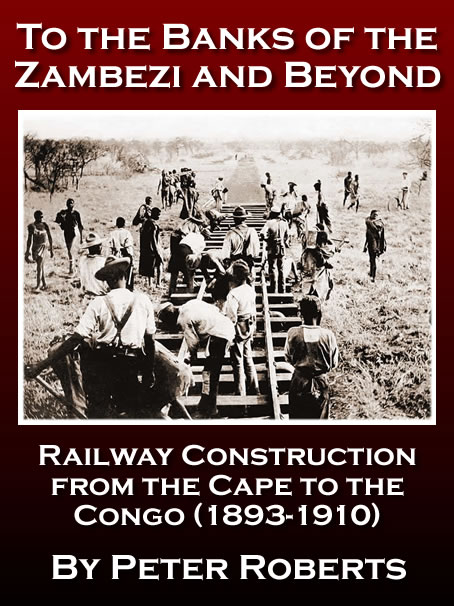
The following text is adapted from 'To The Banks of the Zambezi and Beyond - Railway Construction from the Cape to the Congo (1893-1910)', researched and written by Peter Roberts and first published in 2021. Please visit the Zambezi Book Company website for more information.
On To Broken Hill
After Kalomo the next target for the railway were the zinc and lead mines at Broken Hill (Kabwe). The contract was again awarded to Pauling, who committed to build the 281 miles (452.2 km) of track from Kalomo to Broken Hill in 277 working days. From Bulawayo the line had been financed by the Rhodesia Railways, but for this section it was the Mashonaland Railway Company that funded the construction.
"During 1905 the newly-discovered lead deposit at Broken Hill was being developed to the stage where rail transport was essential, as it was expected that production would call for a train a day. This was the magnet for the extension of the line from Kalomo. From Bulawayo the line had been financed by Rhodesia Railways, but for the next stretch it was the Mashonaland Railway that provided the funds. Once more the job was given to Pauling."
George Pauling’s cousin, Harold, who had been in charge of the construction from Vryburg, died suddenly on 3rd May 1904, soon after the line had arrived at the Falls, and his role was taken over by Mr Alfred Lawley.
"Harold Pauling, who had been chief agent, had died soon after the line reached Victoria Falls and A L Lawley had taken charge at Livingstone with P St G Mansergh doing the preliminary survey. A contract had been accepted by George Pauling for the 281 miles [452.2 km] from Kalomo to Broken Hill to be built at the rate of a mile a day, so that once again Lawley was faced with a target only a man with unbounding enthusiasm and inspiration could achieve. For the railways, H F Varian was the local resident engineer with headquarters at Bulawayo." (Croxton, 1982)
In late August 1905 the Bulawayo Chronicle reported work was progressing rapidly.
"Very rapid progress is being made in the construction of the railway line to the Broken Hill Mine in North-Western Rhodesia. The contract rate of progress is one mile per day and this is being well maintained so that the whole work will probably be completed by June next year. Material is now being forwarded by wagons from the railhead for the Kafue River Bridge. As soon as the rails have been laid as far as the river, the material for the remainder of the line will be conveyed across the Kafue by means of a large pontoon, and thus rail laying on the northern side of the river will be continued without interruption All the material for the bridge is being imported from England, and so extensive a piece of engineering is it, that the line will have probably reached Broken Hill before the bridge is completed. The health of the 800 whites and 6,000 natives employed on the construction work has been remarkably good throughout this year." (Bulawayo Chronicle, August 1905b)
Varian later wrote a detailed account of his role in the development of the railways.
"The contract for construction of the line to Broken Hill at the rate of a mile a day was in its stride right from the start. The route lay across the Batoka Plateau, on which the earth-works were light, with only surface openings, and no appreciable waterways or bridgework until the line reached a point some forty miles [64 km] south of the Kafue River. In this section there are four bridges of 100 feet [30.5 m] over the rivers draining into the Kafue itself, and several lesser ones... This rapid advance was first checked by the necessity of bridging the Magoy River, the first bridge of any importance after the crossing of the Kalomo River, over 100 miles [161 km] to the south. The temporary bridging of the other three rivers between Magoy and Kafue, the Mazabooka, the Calai, and the NegaNega, caused further delay, but in spite of this, rails reached the Kafue three months ahead of the contract time of a mile a working day." (Varian, 1953)
Varian worked closely with Mr E R Marsland, engineer for Pauling and Company, in preparations for the bridging of the Kafue.
"Mr E R Marsland was my opposite number for Paulings’ on field-works during the mile-a-day contract from Kalomo to Broken Hill - 281 miles [452.2 km] in 277 working days, truly a young man’s job. He was then twenty-six years old, and I was twenty-nine. Our only transport on the works, apart from that on the line, was a cart with six mules, and two ponies apiece. Those were the days before motors - which would have served us much better." (Varian, 1953)
Towards the end of September the Bulawayo Chronicle reported on progress.
"The rails have been laid 160 miles [257 km] north of the Falls, and it is expected the earthworks will be completed to the Kafue in about four weeks’ time. Material for the Kafue Bridge is being forwarded by waggon transport, and the final survey to Broken Hill will be finished about the 22nd October." (Bulawayo Chronicle, October 1905)
Track-laying on the line to Broken Hill
Bridging the Kafue
A major hurdle for the line north was the bridging of the Kafue River, one of seven bridges on the line and again designed by George Hobson of Sir Douglas Fox and Partners. The bridge consisted of 13 steel girder spans 100 feet (30.5 m) in length, giving a total length of 1,365 feet (416 m).
"Measured from bank to bank, the river was about fifteen hundred feet in width, or nearly double that of the Thames at Westminster Bridge. The country on either side of the river is quite flat, and the level of the water varies only a few feet even in flood time. A short distance below the site of the bridge the river falls many hundred feet, so that there was no need to allow headroom for steamers." (Metcalfe, 1923b)
The wide floodplains of the river were reached in mid-February 1906. A causeway was made from each bank, fourteen concrete piers were built, and thirteen steel spans of one hundred feet (30.5 m) each were erected. The steelwork sections, supplied by the Patent Shaft and Axletree Company of Staffordshire, England, were built up and riveted on the south bank of the river (Metcalfe, 1923b).
"The spans of the bridge, which is of the lattice girder type, are supported on masonry piers, each 18 ft. [5.5 m] wide by 8 ft. [2.4 m] thick. The rock and gravel foundation of the bed of the river gave a first-class foundation. The piers were pushed forward during the dry season, and the steelwork was set directly the river was at flood-level. Timber coffer-dams were erected round the sites of the piers, and the interior was pumped clear of water to enable the workmen to set the stones.
"While this work was proceeding other gangs were riveting the steelwork of the bridge. Each 100 ft. [30.5 m] span was 14 ft. [4.2 m] wide, 20 ft. [6 m] high and weighed fifty-six tons... By the time the masonry of the piers was finished the spans were ready." (Anon, 1935a)
A pontoon, designed by Mr Lawley and costing £3,750, was used to facilitate the bridge construction, as well as ferrying railway materials across the river.
"Designed by G A Hobson and destined to have 13 spans of 100 ft. [30.5 m] each, it was to be at that time the longest bridge in Africa. Accordingly it posed a formidable challenge to Arthur Lawley, but he rose magnificently to the occasion. His massive pontoon, 95 ft. [29 m] long, 45 ft. [13.7 m] wide and 5 ft. [1.5 m] deep, could carry either a locomotive or two trucks. Spans were slid one at a time on to the pontoon, and hauled out into the stream to be floated into position. Once in the right place, they were raised by hydraulic jacks to their resting place on top of the piers. All 13 spans were put into place within eight days." (White, 1973)
Photographs show at least two engines being floated across the Kafue by means of Lawley’s pontoon during this period, a 4th Class 4-6-0 (No.75) and a 7th Class 4-8-0. The 100 miles (161 km) of line from the Kafue to Broken Hill, were built entirely with materials ferried across the Kafue River on the steel pontoon.
"The bridge... took six months to build, and the contractors (Messrs Pauling) and all concerned in its construction are naturally very proud of it. ‘The River Kafue,’ said Sir Charles to our representative, ‘differs from most of the rivers in Africa in that for a considerable part of it - for 100 miles [161 km] at least above the bridge - it is navigable. In regard to the bridge, I consider that wonderful progress was made with it. The contractors organised an excellent method of pushing the work, and constructed a big pontoon, which carried about 150 tons of material, to facilitate matters.’ The bridge is in 13 spans of 100 ft. [30.5 m], the concrete pillars being built by the caisson system, in 6 ft [18 m] of water." (New Zealand Herald, November 1906)
The total cost of construction was £50,000.
Last Dash
The last 110 miles (177 km) of line from the Kafue to Broken Hill were built entirely with materials ferried across the Kafue River on the steel pontoon. It was not until after the section was completed, and the line ready for handing over to the Railway Company, that the first train crossed the completed Kafue Bridge in late July 1906.
"Beyond Kafue the country was broken and hilly with heavier work for the contractor to surmount the 1 in 64 rising grade to the vicinity of where Lusaka now stands. Despite this, earthworks and platelaying went ahead without delay." (Croxton, 1982)
The railway construction gangs again showed off their skills as they reached the end of the work:
"The earthworks were well ahead and soon completed, with the plate-laying close behind. Broken Hill was reached on 11th January 1906, thus fulfilling the contract in the specified time. Some of the plate-laying gangs had been with Paulings’ on the work for many years, in some cases even from the start of the line from Vryburg in South Africa. As a final exhibition of their skill, the last half-mile into Broken Hill was laid with materials off-loaded from the plate-laying train behind, carried forward by hand, and laid with such rapidity that the train passed over the newly-made track without a pause, or even a slackening of the turning of its wheels... Parallel to that final rush, in the heat and dust and noise, a herd of oxen was being driven up to be handed over by Lawley as a present to the plate-laying gangs at the finish of the work.
"The last dash was recorded in a cinematograph picture. Cinema photography was then in its very early infancy, and the Pathé cine man who braved the wilds was, as far as I know, the first to come to Rhodesia. He had a very energetic morning, busily dodging from one antheap to the next (and there were many antheaps in that country) in his attempts to keep abreast of it all... He also took some pictures of the launching of the steel spans of the Kafue River Bridge, on the occasion when three were launched in one day." (Varian, 1953)
On 11th June 1906 Mr Lawley sent a telegram to Mr Corner, now Resident Engineer in Bulawayo, announcing simply “Rails arrived Broken Hill” (Corner, 1906).
The Line at the Mine
On 20th June 1906 the Administrator of North-Western Rhodesia, Major Robert Coryndon, and a number of Company officials arrived by construction train at the end of the line.
"The opening of the Broken Hill extension was celebrated on Wednesday, June 20th 1906, a bitterly cold day when a special train conveying visitors and officials from Bulawayo arrived at five o’clock in the morning.” (Rhodesia Railways Magazine, November 1959)
Present to welcome the party was the Australian prospector, Mr Thomas Garfield Davey, who in early 1902 had discovered the zinc and lead deposits and named the site ‘Broken Hill’ (now Kabwe, some 600 kilometres north of the Zambezi), after a mining town in New South Wales, Australia. Mr Davey was now chief representative of the Broken Hill Development Company formed to exploit the mineral resources, and wasted no time in marshalling the eager arrivals to assist in the work.
"On the 20th inst, H.H. the Administrator (Mr R T Coryndon) accompanied by Messrs F J Newton, CMG, S M Langagan O’Keefe and D Hawksley, arrived here on the invitation of Mr T G Davey, the General Superintendent and Consulting Engineer of the Broken Hill Development Company, to celebrate the arrival of the railway, and the loading of the first consignment of ore from the mine. On the following morning there was a large gathering at the railway station, close to No.2 kopje, where a truck was in readiness.
"Mr T G Davey, in the course of a brief speech, alluded to the excellent work which had been done by the railway contractors, Messrs Pauling & Co, who had in fact, he said, broken all previous South African records in laying the line from the Victoria Falls to Broken Hill... [His Honour] the Administrator had been asked to come to Broken Hill to fill the first bag of ore for shipment to England. Turning to Mr Coryndon, Mr Davey continued: ‘I have the honour to present to you a little shovel, and to ask you if you will kindly fill this truck with it.’ He then handed the Administrator a very neat silver trowel, which had been suitably inscribed.
"In replying, the Administrator expressed his appreciation at having been requested to undertake this ceremony. It was no small thing, he said, to be instrumental, even in a small way, in assisting the progress of what must eventually become an immensely valuable industry in this territory... He greatly valued this occasion because, he might say, they were putting a peg in the development of the country - the pioneer stage was now past - and the railway had been brought to Broken Hill in spite of tremendous opposition...
"After some further remarks, His Honour concluded by calling for three cheers for the mine, which were heartily given; and then he proceeded to fill the first bag of ore to be sent away from Broken Hill. He expressed the hope that that bag would be but the first of many, many thousands, in fact millions. Mr Coryndon then called for three cheers for Mr Davey, which needless to say, elicited an enthusiastic response.” (Bulawayo Chronicle, July 1906)
A few days later, on the 25th June 1906, the first through train reached Broken Hill, crossing the now completed Kafue bridge and carrying a select gathering including George Pauling, Arthur Lawley, Doel Zeederberg and other notable guests.
"Early this morning Messrs George Pauling, Butler, Lawley, Simkins, Clery, Mr and Mrs Zeederberg and Dr Krauser arrived by special train from the south. After making an inspection of the various zinc and lead kopjes, with which they were apparently much impressed, the visitors were entertained to lunch at the mine camp and shortly afterwards left for the Victoria Falls. This train, which consisted of four saloon carriages and a large number of tucks, was the first to cross the magnificently constructed bridge over the Kafue River. The party making the survey for the extension of the railway to Bwana M’kubwa start work tomorrow morning." (Bulawayo Chronicle, July 1906)
Unofficial Opening of the Kafue Bridge
Varian recalls travelling up to the opening of the line to Broken Hill on the first official train, in company with George Pauling and others. On crossing the Kafue Bridge, Pauling dropped off a coach containing food and drinks for the workmen, before the party continued on to the official opening of the line at Broken Hill.
"There was no formal ceremony, in fact the opening was decidedly informal. A train came up from the south consisting of Paulings’ coach, with George Pauling, Doel Zeederberg of South African stage-coach fame, and James Butler, of Pauling & Co, Lawley’s coach, with S F Townsend, Chief Resident Engineer from Bulawayo, and other visitors; and my service coach. Paulings’ coach was at the rear of the train, with a four wheeled truck attached containing hams and other foodstuffs, and cases of drinks for the bridge hands. During the construction of the bridge, Lawley had forbidden any liquor in the camp south of the river, so this was the first hard drink they had seen for a long time.
"The train stopped at the camp on the south bank, and loaded all the hands onto the truck behind, which was on the same level as the platform of Paulings’ coach, where we were all standing. It crossed the bridge slowly in the light of the sunset, and stopped clear of the bridge on the northern shore. Cases were opened, drinks were served, and many toasts were drunk. The gang undertook to push the truck back to the siding on the south side again, so it was uncoupled, and our train moved on to Broken Hill. When we returned a couple of days later, a sorry sight met our eyes. Judging from the quantity and quality of the black eyes and other casualties, the bridge had been well and truly opened; each riveting squad had celebrated the occasion separately, by individual trails of strength in pushing the now much travelled truck over the bridge and back again." (Varian, 1953)
Excessive Expectations
It had been expected that mine production would call for a train a day, but the service was quickly cut to only two trains a week, and soon after only one.
"The train service consisted of two mixed trains each way weekly taking 30½ hours from Livingstone to Broken Hill and 32 hours on the southward trip, while a special good train was run when required. The trains were hauled by 7th or 8th class engines with two crews working the round trip of 740 miles [1,190 km] on the caboose system.
"Unfortunately, after moving 13,428 tons of ore from Broken Hill, this traffic suddenly ceased in May 1907 owing to difficulties in the treatment and separation of the lead and zinc ores at the refinery in Wales. So the expected daily train did not materialise and the service was cut to one train a week." (Croxton, 1973)
|
References
Anon (1935a) Progress in Rhodesia. Railway Wonders of the World, Pt.27, 2nd August 1935, p.867-868, and Pt.28, 9th August 1935, p.869-874.
Bulawayo Chronicle (August 1905b) Livingstone Notes. 26th August 1905.
Bulawayo Chronicle (October 1905) Livingstone Notes. 7th October 1905.
Bulawayo Chronicle (July 1906) Northern Railway at Broken Hill. 7th July 1906.
Corner, C. (1906) Telegraph from Sir Charles Metcalfe to Charles Corner. 11th June 1906. Private collection.
Croxton, A. (1982) Railways of Zimbabwe.
Metcalfe, Sir C. (1923b) The Kafue River Bridge. [In Weinthal, L. [Editor] (1923), Vol.II]
New Zealand Herald (November 1906) Cape to Cairo Railway - Progress of the Work. Volume XLIIl, Issue 13345, 27th November 1906.
Pauling, G. (1926) Chronicles of a Contractor.
Rhodesia Railways Magazine (November 1959) Golden Jubilee of line to Congo Border. Vol.8, No.7, p.23.
Varian, H F (1953) Some African Milestones Wheatley : George Ronald. (Reprinted 1973 Books of Rhodesia).
White, B. (1973) The Trailmakers, The Story of Rhodesia Railways. Supplement to Illustrated Life, Rhodesia, 31st May 1973.
Further Reading
Roberts, P. (2021) To The Banks of the Zambezi and Beyond Railway Construction from the Cape to the Congo (1893-1910). Zambezi Book Company.

|
|
Search www.tothevictoriafalls.com:
|
'To The Victoria Falls' aims to bring you the wonder of the Victoria Falls through a look at its natural and human history.
This website has been developed using information researched from a wide variety of sources, including books, magazines and websites etc too numerous to mention or credit individually, although many key references are identified on our References page. Many of the images contained in this website have been sourced from old photographic postcards and publications and no infringement of copyright is intended. We warmly welcome any donations of photographs or information to this website.
 Website text © Copyright Peter Roberts 2012, All Rights Reserved.
Webpage design by EcoElements Digital Media Solutions
|