To The Victoria Falls
Development of the Railway
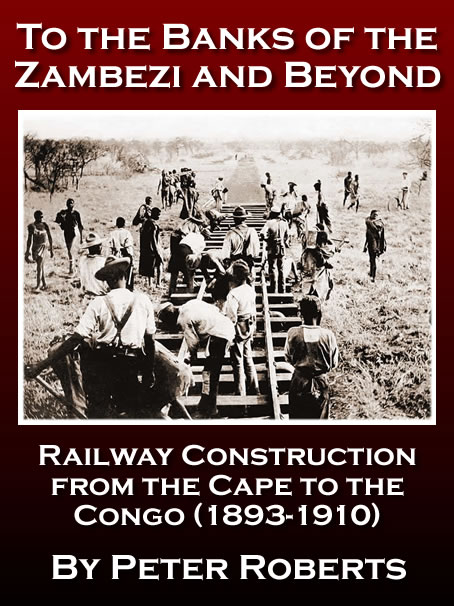
The following text is adapted from 'To The Banks of the Zambezi and Beyond - Railway Construction from the Cape to the Congo (1893-1910)', researched and written by Peter Roberts and first published in 2021. Please visit the Zambezi Book Company website for more information.
Carts and Coaches
The only regular transport covering the 850 kilometre journey onwards to Bulawayo was the weekly Zeederberg coach. The lurching journey took five to six days when the mules were in good health and the road in good condition.
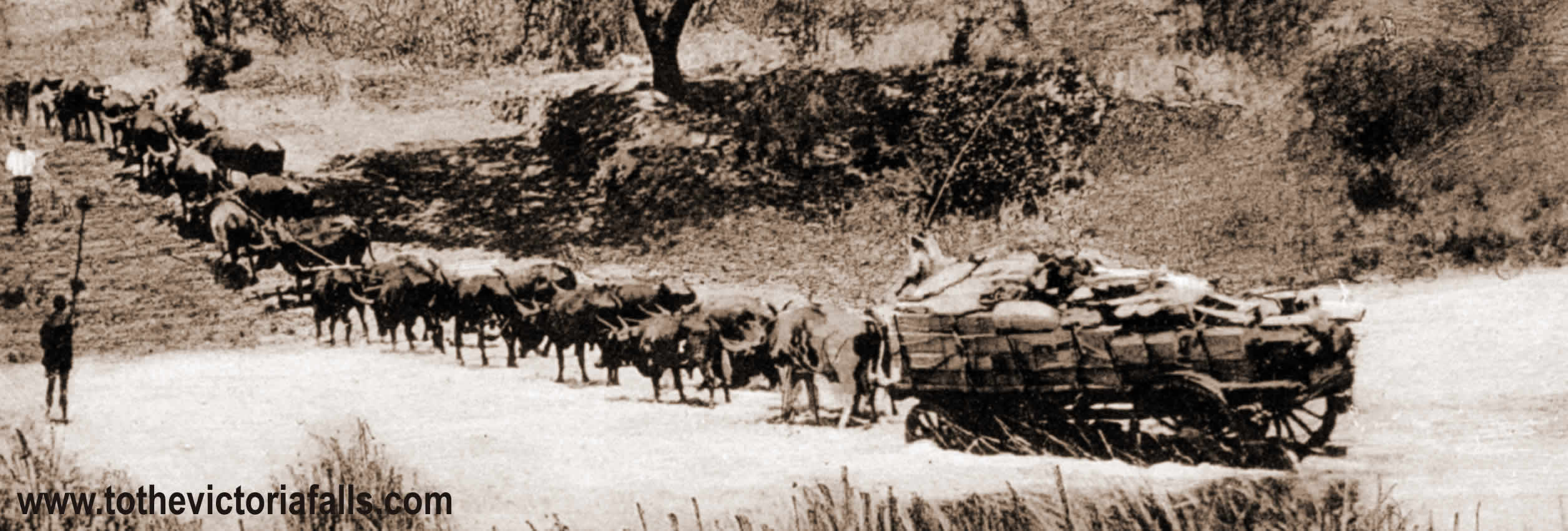
"Everything, from the smallest home necessity to heavy farm and mine equipment, had to be transported by lumbering wagon drawn by oxen or mules. It was agonisingly slow, hazardous and very expensive. When Bulawayo became the latest dusty outpost of the British Empire after the occupation of Matabeleland by troops of the British South Africa Company in November 1893 its streets were laid out wide enough to allow a wagon and full span of sixteen oxen to turn around (and they remain so today, a striking feature of the city)." (Jones, 1997)
Wagons crossing drift
Zeederberg Coach Company
In 1890 Cecil Rhodes had commissioned Doel Zeederberg to survey the new Rhodesia territory and suggest likely transport routes, and the first regular coach service was opened the same year. Doel was a shrewd businessman and superb horseman, surveying most of the routes himself over the next three years. Doel would become known as the ‘coaching king’ of southern Africa.
Christiaan Hendrik Zeederberg, or ‘Doel’ as he was known, together with his three brothers Dolf, Louw and Pieter as partners, established Zeederberg and Company, Coach Proprietors in 1887, later known as the Zeederberg Coach Company. Their first mail-coach route, between Johannesburg and Kimberley, began operating in the same year.
Restored Zeederberg coach (Bulawayo Museum)
The coaches were of American manufacture, lightly built and wheeled but remarkably robust. They carried up to twelve passengers with room on top for mail and baggage and were usually drawn by ten mules, which were changed at regular coaching stations at 10 to 15 mile (16-24 km) intervals, allowing the coaches to travel continuously without delays.
By October 1894 the railway had reached Mafeking, with the only regular transport covering the 850 kilometres to Bulawayo the weekly Zeederberg coach.
"The Zeederberg bothers were also contractors for the transport of Royal Mail from one centre to another. This service was not economic, therefore Zeederberg’s was subsidised to a total amount of £11,000 per annum by the postal authorities. This sum was reduced in proportion as the coach services were replaced by railways. The coach took ten days for the journey from Mafeking to Bulawayo, travelling day and night. The fare on 5th June, 1895 between these two points was £45." (Cooke,1975)
The lurching journey took five to six days when the mules were in good health and the road in good condition, and the week-long journey was scheduled: Boulderpits - Monday midnight, Gaberones -Tuesday 5 a.m, Palapye - Friday noon, Tati hotel - Sunday 6 a.m, Mangwe Pass - Sunday midnight, Bulawayo - Monday 9 p.m.
The following description appeared in 1894, describing the route to Bulawayo:
"In fine weather, when the roads are in good condition, a coach journey may be very enjoyable, but in bad weather capsizes are unpleasantly frequent and occasionally a coach with its freight and passengers will stick in the mud for many hours. Teams are changed every ten or fifteen miles [16-24 km], and some idea may be inferred of the number of horses and mules kept at the different stations from the fact that frequently four or five coaches will require fresh teams at one place during the day. The rate of travelling, including stoppages, is not much more than six mph. Fares are high, ranging from 9d. to 1/- per mile. The allowance of luggage per passenger ranges from 25-40 lb. [11-18 kg], and every additional pound weight is charged... extra according to the distance travelled, whilst, if the mail should happen to be heavy, luggage is frequently shut out." (Rhodesia Calls Magazine, 1973)
The Zeederberg coaches ran for a number of years across the Rhodesias, opening new routes and hailing the coming of the railway, before the advancing rails made their services redundant.
Doel Zeederberg died in 1907. Rhodes himself said that no other individual had done more to open up Rhodesia than Doel Zeederberg.
"In his own sphere of activity Doel may be said to have been among the few who played a leading part in the development of Central South African resources. In conjunction with Cecil Rhodes, this sturdiest of pioneers recognized the potentialities of the great North Land." (Beet, 1923)
Rail Rates and Coach Connections
An advertisement published in 1896 by the Cape Government Railways offered “the cheapest and most direct route to Matabeleland, Mashonaland, Barotseland, and northern territories via Mafeking.”
"Goods rates for the 870 miles [1,400 km] from Cape Town to Mafeking, under ‘Railway Bond,’ in transit for these countries were conveyed at the following rates per 100 lb. [45 kg]: 10s 10d; 9s and 6s 7d; with special rates as 7s 8d; 7s and 5s 2d. The special rate column (a) embraced such articles as agricultural implements, candles, coffee, dynamite, soap, sugar and timber. Column (b) included galvanised iron (plain or corrugated), imported flour and meal. Special rate column (c) covered rough timber in logs, planks, boards, etc. in 5-ton loads.
"Rail passenger services from Cape Town, Port Elizabeth and East London converged on Mafeking. The journey from Cape Town took 54 hours, the first class fare being £9 15s 4d, second class £6 13s 8d and third class £3 12s 6d. Services ran daily. A fast passenger train ran weekly carrying first class passengers only. Meals were available at stations en route from 2s 6d to 3s. per head. On mail trains meals were served ‘in the cars.’ Bedding was hired out at 2s 6d.
"Passenger travel beyond Mafeking was by coach, which offered a daily service, the coach leaving two hours after the arrival of the train. Most of the coaches were of American manufacture and were drawn by ten mules. The journey from Mafeking to Bulawayo, a distance of 525 miles [845 km], was completed in five to six days when mules were in condition, but frequently took longer. Coaches seldom stopped more than an hour or two at a time beyond the time occupied in changing mules.
"These apparently flimsy vehicles with their lightly-built frames, spidery wheels, bodies slung by leather springs to the ‘C’ springs could stand up to much rough usage. In addition to their 12 passengers they carried a ton of more of mail and baggage and averaged at least seven miles [11 km] an hour over hills and through rivers, changing teams at post stations every 10 to 20 miles [16-32 km]. It took two to drive. The famous Zeederberg mail coaches could do 150 miles [241 km] or more, depending on weather conditions, in a 24-hour run. Passengers were allowed 30 lb. [13.6 kg] of luggage, excess being charged at the rate of 1s 6d per lb. Heavy baggage was required to follow by wagon and could be up to two months on the road."
Meals could be obtained at Mochudi, Palla, Palapye and Tati which were approximately 24 hours travelling time apart. Between Tati and Bulawayo the facilities were more numerous.
"After the fast mail coach there was a variety of road transport in operation, ranging from the mule- or horse-drawn Cape cart, to the Scotch cart, mule wagon, ox wagon and donkey wagon. Of these the Cape cart, drawn by four or six animals, was the speediest method of travel. Mules in good condition would travel from 30 to 35 miles [48-56 km] a day compared with horses which managed no more than 25 to 30 miles [40-48 km]. A Cape cart cost between £70 and £90, mules from £15, and horses from £12. Following the rinderpest which killed off the oxen in their thousands, the mule became the principal means of transport. A light wagon capable of carrying 4,000 lb. [1,814 kg] drawn by eight to ten mules, completed 12 to 15 miles [19-24 km] a day.
"Scotch carts were used for loads of 1,500 to 2,000 lb. [680-907 kg], such a vehicle taking about 20 days to reach Bulawayo.
"Until the rinderpest ravaged the cattle, the ox wagon was the only means of transport of heavy good north of the railhead, a wagon carrying up to 8,000 lb, [3,628 kg] and taking two months to reach Bulawayo. They attained 2 to 2½ miles [3.2-4 km] an hour and journeyed for about eight hours out of the 24, much of this being done at night. Travel by this means required the experience of a transport rider whose services were available at £40 to £60 per trip. Transport riders were prepared to carry passengers for about £5, charging for luggage at the current rates of transport per 100 lb. [45.3 kg].
"Slowest of the services on offer was donkey-drawn transport, 18 to 20 of these animals being used to draw a load of about 4,000 lb. [1,814 kg]. They achieved 1 to 1½ miles [1.6-2.4 km] an hour and at best made 10 to 12 miles [16-19 km] a day. However, donkeys had the advantage, for the unhurried traveller, of being free from the diseases which struck the other transport animals; they were relatively inexpensive, costing about £2 10s to £3 before the rinderpest, although they later commanded up to £6." (Bolze, 1968)
The rough condition of the roads was not always the only cause of concern for adventurous travellers.
"Zeederberg coaches ran on several sections on the north run in the early days. At intervals of ten miles [16 km] animals were changed. Due to the nature of the terrain over which coached plied, tickets carried this intimation: ‘The contractors will not hold themselves responsible for loss or damage caused by the capsizing of the coach, unless this is due to the drunkenness of the driver.’" (Rhodesia Railways Magazine, November 1957c)
Impatient Traders
In early 1895 a passenger on the mail coach recorded counting over a hundred wagons on a 200 mile (321 km) stretch to Bulawayo alone, and a report prepared by the Chamber of Commerce recorded more that 2,000 wagons had arrived at Bulawayo over a twelve month period.
"Early in 1895 the Bulawayo Chamber of Commerce was concerning itself with transport problems. It discussed the acute need for speedy and reasonably priced transport of heavy machinery for the gold-mining industry. By October of that year merchants were complaining of a serious transport difficulty and the delay of getting consignments from the south. Owning to the scarcity of wagons they were at their wit’s end to fulfil orders in various parts of the country. Bulawayo was by then a distributing centre of the first importance. Mining camps and smaller towns north, south, east and west looked to her warehouses for their necessary supplies.
"A report prepared earlier in the year by a Railway Committee of the Chamber recorded that during the previous 12 months ‘upwards of 2,000 wagons had come into Bulawayo and the cost of transport amounted to £140,000.’ At about the time of the preparation of the report merchandise in transit for Bulawayo was arriving at Palapye in enormous quantities, a passenger on the mail coach to Mafeking reporting that he had counted over 100 wagons on the road between Palapye and Bulawayo." (Bolze, 1968)
The Bulawayo Chronicle of the 5th April, 1895, recorded the anxieties of the settlers:
"Of all questions that are now agitating the minds of the settlers of Matabeleand there is none so burning as the question of railway extension... the hope of the country... rests with the Bechuanaland Railway." (Bolze, 1968)
Rhodes Resigns
In late 1895 Rhodes was implicated in a failed plan to send an armed column into the Transvaal in support of a planned uprising within the Boer Republic. The fall-out from the infamous Jameson Raid, led by Dr Jameson (then Administrator of Southern Rhodesia), forced Rhodes to resign as Prime Minister of the Cape Colony in January 1896, and as Chairman of the Chartered Company later the same year. Dr Jameson resigned as Administrator in April 1896.
|
References
Beet, G. (1923) The Story of the Ox Wagon - The Story of a Famous Engineering Feat. [In Weinthal, L. [Editor] (1923) Vol.I]
Bolze, L. W. (1968) The Railway comes to Bulawayo. Rhodesiana, No.18, July 1968, p.47-84.
Cooke C K (1975) The Zeederburg Coach, Rhodesianna, No 32, March pp 43-7.
Jones, D. (1997) 100 Years The Railway in Zimbabwe 1897-1997. Pangolin Press, Harare.
Rhodesia Calls Magazine (1973) How ‘Wild West’ coaches opened up Rhodesia. White, P. J. May-June 1973.
Rhodesia Railways Magazine (November 1957c) Zeederberg Days. Vol.6, No.7, p.61. [BRMA]
Weinthal, L. (1923) The Story of the Cape to Cairo Railway and River Route from 1887–1922 (Pioneer Publishing Co)
Further Reading
Roberts, P. (2021) To The Banks of the Zambezi and Beyond Railway Construction from the Cape to the Congo (1893-1910). Zambezi Book Company.
|

|
Search www.tothevictoriafalls.com:
|
'To The Victoria Falls' aims to bring you the wonder of the Victoria Falls through a look at its natural and human history.
This website has been developed using information researched from a wide variety of sources, including books, magazines and websites etc too numerous to mention or credit individually, although many key references are identified on our References page. Many of the images contained in this website have been sourced from old photographic postcards and publications and no infringement of copyright is intended. We warmly welcome any donations of photographs or information to this website.
 Website text © Copyright Peter Roberts 2012, All Rights Reserved.
Webpage design by EcoElements Digital Media Solutions
|