To The Victoria Falls
Development of the Victoria Falls
Aviation Adventures
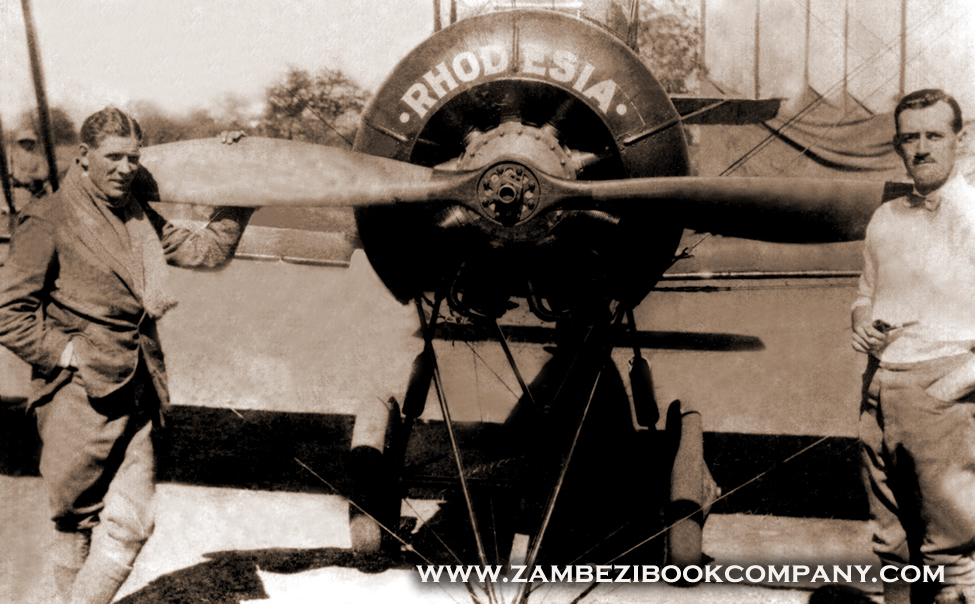
A few months after the arrival of the Silver Queen II, in early May 1920, the newly established Airoad Motors Ltd advertised a six month tour of Northern and Southern Rhodesia, offering private pleasure flights to civilians. The aircraft, a converted military Avro 504K owned by the South African Aerial Transport Company, arrived in Bulawayo on 24th May. Two pilots, Mr C R Thompson and Mr Earle Rutherford, were employed for the tour. On 21st July 1920 the ‘Rhodesia’ arrived at Livingstone, with Miss Ely and Mr Brooker recorded as the first farepaying passengers to undertake a sight-seeing flight over the Falls (Stirling and House, 2014).
Rutherford and Thompson with the 'Rhodesia'
During the mid-1920s the newly established Imperial Airways (formed in 1924) were exploring potential commercial aviation routes, with long-distance pioneering test pilot (later Sir) Alan J Cobham becoming the first to fly from England to Cape Town and back in 1925-6. Supported by Arthur B Elliott as engineer and Basil W G Emmott as cinematographer, the flight set out from Croydon Aerodrome, London in a de Havilland DH.50J (G-EBFO) on 16th November 1925. The plane had been fitted with a 385 horse-power Armstrong Siddeley Jaguar engine to provide the extra power needed for take-off in the rarefied high altitude air of the central African plateau. Crossing Europe and the Mediterranean to Cairo, and then flying in stages southwards through the Nile valley and central Africa they eventually reached the rising spray of the Victoria Falls.
“This spray might easily have had serious consequences for the fliers. Intent upon securing good photographs of the great spectacle they ventured to fly down to 50 feet [15 m], and within 50 feet [15 m] of the brink of the chasm. Suddenly, the spray enveloped them in a great cloud, and simultaneously the engine spluttered and threatened to fail, for the first time since the fliers had left London. The water of the spray had entered the carburettor. Engine failure in such a position would probably have proved fatal, and there were some anxious moments while the spluttering continued. Cobham had instinctively pulled back the control lever, and the machine climbed rapidly. He had opened the throttle full out to give the propeller momentum, and the maximum chance of overcoming engine failure while the carburettor cleared. He was successful, and within a few minutes had gained sufficient height to glide down to the landing ground at Livingstone.” (Wonders of World Aviation, 1938)
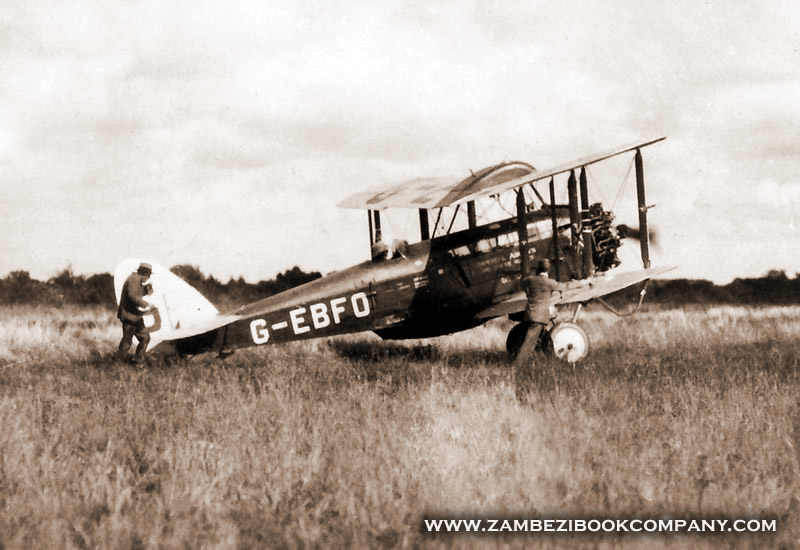
DH.50 G-EBFO ready for take-off from Bulawayo.
February 1926
The flight successfully reached Wynberg Aerodrome, Cape Town on 17th February 1926. Departing for the return journey on 26th February 1926, Cobham raced against the Union Castle Line ‘Windsor Castle’ - arriving back at Croydon on 13th March and beating the ship back to England by three days (Stirling and House, 2014).
Knighted for his pioneering aviation achievements, Sir Alan Cobham returned to southern Africa as part of a round Africa flight in 1927-8, piloting a Short S.5 flying-boat (G-EBUP) ‘Singapore I,’ on a 18,115 mile (29,153 km) journey lasting six months. Powered by two Rolls-Royce 650-700 horse-power Condor engines and carrying a support team of five, including Lady Cobham, their route took them along the Nile to Lake Victoria, Biera, Durban and Cape Town before returning via the west coast.
In 1926 the Royal Air Force made the first long distance formation flight from Cairo to the Cape and back with a detachment of four Fairey IIID biplanes, led by Wing Commander C W H Pulford. The expedition became an annual event, with four Fairey IIIF biplanes undertaking the journey in 1927, 1928 and 1929.
Towards the end of the 1920s the challenge of the London to Cape Town route attracted many early aviators to risk their lives in attempting the journey. In 1927 Flight-Lieutenant Richard Read Bentley, a South African Air Force instructor, completed the first solo England-Cape Town flight in a de Havilland DH.60G Cirrus Moth (G-EBSO). Bentley departed from London on 1st September, arriving at Cape Town on 28th September 1927. The following year he completed the return journey, departing Cape Town on 3rd March and arriving at Croydon, London on 12th May 1928.
Aerial Surveys
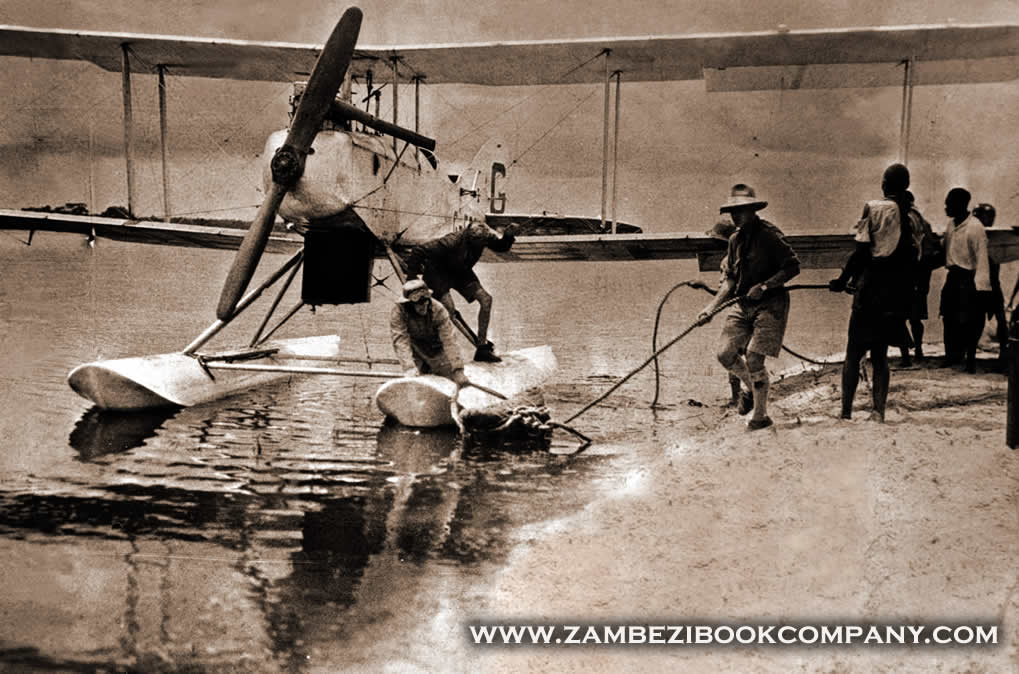
In 1927 the British-based Aircraft Operating Company secured the contract for an extensive aerial photographic survey of the Upper Zambezi, flying vast transects over areas of uncharted territory. As part of the survey Captain G H Trace (pilot) and Mr R T Steve Launder (engineer) experimented using a DH.9 biplane customised with floats allowing take-off and landing on water. The plane's engine was only just powerful enough and Trace recorded the plane struggled to get ‘unstuck’ from the river and gain altitude during take-off.
DH9 on THE Zambezi
Operating frequent logistic support flights between Bulawayo and Livingstone, the company came to the rescue of stranded Hotel guests during a railway strike which took effect from 16th February until 6th March 1929. The strike, which brought the entire rail network to a halt, combined with heavy rains which made the rough road from Bulawayo impassable, left the Falls completely isolated. Using the Company's two-seater Puss Moth, pilot Captain J Douglas Mail carried a total of seven passengers back to Bulawayo.
“Aeroplanes to the rescue. In this case it is to help a party of British tourists stranded at Victoria Falls owing to a strike in connection with the Rhodesian Railway. Even motor-cars were of no use, apparently, and the ‘evacuation’ arrangements had to rest upon aeroplanes.” (Flight Magazine, 1929)
Those not evacuated by air extended their stay at the Hotel until the 2nd March when the first passenger train left the Falls for the south (Rhodesia Railways Bulletin, April 1929).
The Flight of Angels
In the late 1920s visitors to the Falls could experience a new and breath-taking way to view the Falls - from the above. The short-lived Rhodesian Aviation Company was established with the aim of tapping the tourism potential of the Falls, operating commercial ‘flips’ from June 1929 (McAdams, 1969).
“The company was formally registered on 17th April, 1929, but owing to a serious delay in the delivery of the ‘Bluebird’, the commencement of flying operations had perforce to be postponed... [As] a considerable amount of potential business was being lost, a second-hand Avro Avian aircraft [VP-YAC] was purchased... on 13th June, and was immediately flown up to Livingstone, where it was put to work operating ‘flips’ over the Victoria Falls.” (McAdams, 1969)
The pilot, Captain Benjamin Roxburgh-Smith, was a pilot of some experience with a distinguished flying record during the First World War.
"Captain B Roxburgh-Smith, DFC, Salisbury's Aerodrome Superintendent, was granted a commission in the Royal Flying Corps in 1916. He served in France in two famous single-seater fighting Squadrons (Nos 60 and 74), and brought down twenty-three enemy aircraft. He was awarded the Distinguished Flying Cross, later a Bar to his DFC, and the Belgian Croix de Guerre. He came to Rhodesia in 1920 and settled in the Gwelo district. In 1927 he acquired the first 'B' licence issued by the South African Civil Air Board in order to join the Aerial Survey Expedition operating in the Copper Belt, Northern Rhodesia. In 1929, backed by Sir Alan Cobham, he started the Rhodesian Aviation Company in Bulawayo, and was the first pilot to commercialise flying at the Victoria Falls, thus giving hundreds of visitors the opportunity of seeing the Falls from the air in the season 1929 and 1930." (press cutting, unknown source)
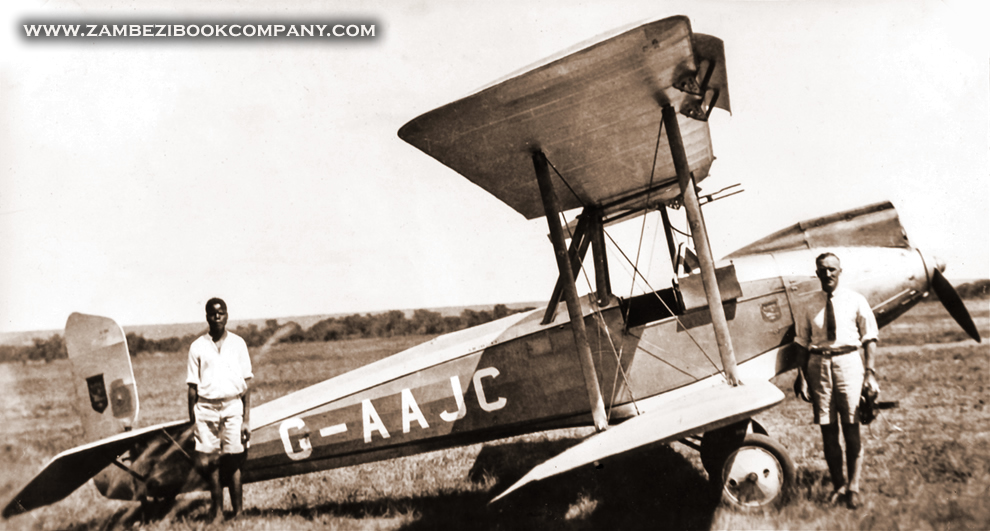
The Blackburn Bluebird IV (G-AAJC), when it arrived, was very popular for flights over the Falls, the side-by-side seating making communication between pilot and passenger easy. A 15 minute flight over the Falls cost £1.
Bluebird Gypsy I (G-AAJC)
Henry Balfour, on the last of his visits to the Falls in 1929 recorded:
“Great changes since 1910. A large and very fine stone hotel has replaced the wood and tin shanties which used to serve as [the] hotel. Many new houses have been built... I went down to the Aerodrome and... went up with Major Smith in an Avro-Avian plane. Flew over the Falls, down to beyond the Masui River and up as far as Kandahar Island. Wonderfully interesting. We flew at about 1,500 ft. [457.2 m]. Made a very good take-off and landing.” (Balfour, 1929)