To The Victoria Falls
Development of the Railway
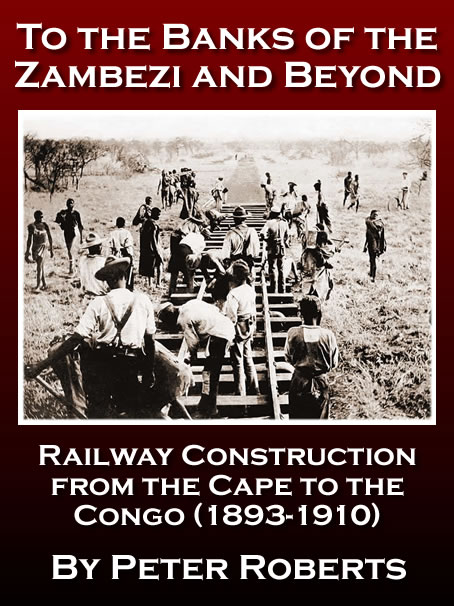
The following text is adapted from 'To The Banks of the Zambezi and Beyond - Railway Construction from the Cape to the Congo (1893-1910)', researched and written by Peter Roberts and first published in 2021. Please visit the Zambezi Book Company website for more information.
Opening of the Line to Bulawayo
The official opening was an event to be celebrated. The day was declared a public holiday and for the following week of events local businesses closed each afternoon to enable the townsfolk to attend the many functions, dinners and parties. Hundreds of guests were invited and a special medallion struck to commemorate the event and which allowed access to all the special events and functions.
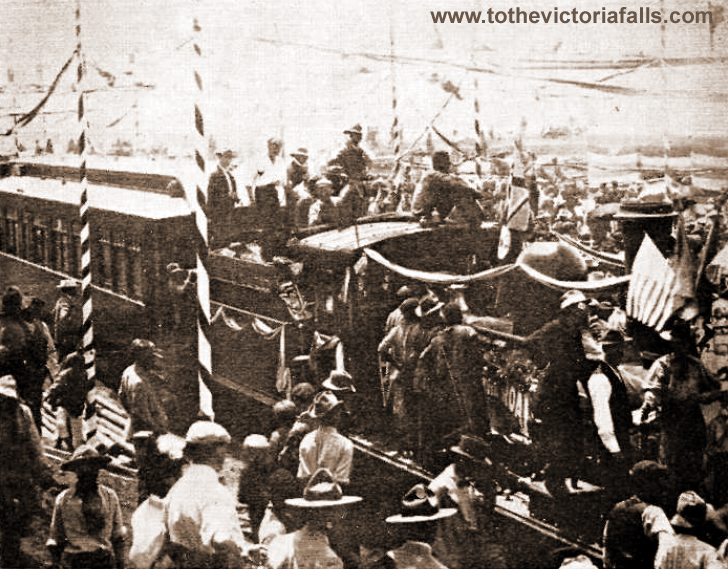
"For the opening ceremony on the 4th November 1897 the temporary railway station was decorated with flags, bunting, greenery and a variety of slogans considered suitable for the occasion. These included ‘Our Two Roads to Progress, Railroads and Cecil Rhodes’ and ‘Change here for Zambesi’ ...The town, too, was gaily decorated and one thrill was the turning-on for the first time of electric lighting in streets and buildings on the evening before the opening day." (Croxton, 1982)
The official opening of railway was celebrated with much pomp and ceremony on 4th November 1897, the fourth anniversary of the occupation of Bulawayo. The specially formed Festivities Committee had been preparing for months for the big occasion. The Railway Company contributed £1,500 to the Bulawayo festivities committee. Four special trains run by the Cape Government Railway arrived carrying 800 guests from all parts of the British Empire.
The Arrival of the Commissioner's Train
The first train, with 96 passengers travelling from the Transvaal, Orange Free State, Port Elizabeth and East London, arrived at seven in the morning. The second, with 60 passengers from Kimberley and Bechuanaland, and including the De Beers director’s coach, arrived half an hour later. Unfortunately the third train, with passengers from the Cape, derailed just before Figtree. No-one was injured, but it did block the line and held up the forth train, carrying many distinguished visitors from England. The four hour delay, to the five-day and 1,360 mile (2,176 km) journey from Cape Town, was a major disappointment for the guests, who missed the opening ceremony and lunch.
There had been concern over possible ‘washaways’ and that the trains might be cut off between flooded rivers in the event of a flash floods, so the trains carried provisions for a month to sustain the important guests through any potential incident. For much of the journey the trains travelled at an average of less than 20 miles (32 km) an hour, with a maximum of no more than 40 miles (64 km) an hour.
Sir Alfred Milner, the new High Commissioner of the Cape (1897-1901), who performed the opening ceremony, arrived two days previously - although his train had also been delayed, ensuring a long wait for the welcoming committee. The High Commissioner spent the night on the train.
"An additional special train for the High Commissioner for South Africa, Sir Alfred Milner, had reached Bulawayo hours late on Tuesday, 2nd November, and the crowd which had assembled to greet him at the station had gone home, apart from the official welcome committee." (Croxton, 1982)
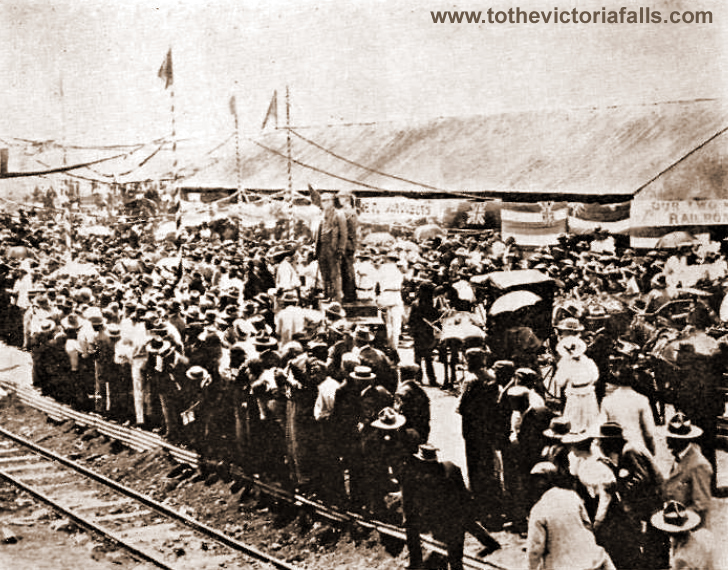
At noon the High Commissioner, Sir Alfred Milner, from a dais on the station ‘platform’ declared the railway from the Cape officially open.
"From as dais on the platform Milner read a message from Joseph Chamberlain, then Secretary of State for the Colonies, and after speeches the opening ceremony was followed by the presentation of the Victoria Cross to Trooper H S Henderson for his bravery during the Matabele rebellion. An official luncheon took place at the recently built Palace Hotel, where invited guests sat down to an impressive menu and wine list. It was typical of George Pauling that he should remember the excellent work done by his employees on the construction and a special chef was engaged to prepare the free meals, with drinks, that he gave his men for the week of celebrations." (Croxton, 1982)
Sir Alfred conveyed a message of appreciation of the work of the settlers from Mr Joseph Chamberlain, the Secretary of State of the Colonies, and through Earl Grey Her Majesty Queen Victoria sent a personal message from Balmoral.
"The Queen desires me to convey to her people at Bulawayo her heartiest congratulations on the arrival of the Railway and her good wishes for their future prosperity - Grey" (British South Africa Company, 1896/7)
By the time the last train of guests from the Cape reached Bulawayo towards evening, the crowds which had all gone home, and the dignitaries moved on to the official luncheon at the Palace Hotel. The opening ceremony had gone ahead without them, although the main speeches were deferred until after the banquet.
Opening ceremony, Bulawayo Station
The manager of the Palace Hotel, Mr G H Clother must have been kept on his toes, with the new hotel still partially incomplete, although amply stocked for the occasion.
"A luncheon followed at the Palace Hotel, incomplete without its third floor but handsomely furbished and amply stocked for the occasion, to the surprise and delight of the guests. The hotel was to be the venue for three banquets during the ten days of festivities... emotionally charged occasions for speeches, innumerable toasts and replies to toasts, and for round after round of hearty British ‘three-cheers’ for everybody associated with the venture." (Jones, 1997)
The distinguished guest list for the “brilliant gathering” read like a ‘Who’s Who’ of nearly everybody who had anything to do with the development of the British Empire in Africa, and many of the leading citizens of South Africa.
At an evening banquet for guests and invited settlers.
"Sir Alfred Milner, the High Commissioner, at a banquet given on the occasion, paid a high tribute to the foresight and energy of Mr Rhodes, and said that even his bitterest enemies would admit his title to a place of honour that night, for he was not only managing director of the line, but prime mover in its construction." (Knight, 1900)
After the speeches “there were three stirring cheers each for Mr Rhodes, Captain The Honourable A Lawley, His Excellency Sir Alfred Milner, and a further and final round for George Pauling were given” (White, 1973).
Responding to a toast to Harold Pauiling and the Engineers of the Bechuanaland Railway, Mr Francis Fox and Sir Charles Metcalfe both gave brief speeches.
"Mr Francis Fox said he should not like to travel fifteen or sixteen thousand miles without having an opportunity of expressing his deep sense of the wonderful skill which Sir Charles Metcalfe had displayed in the laying out of the Bechuanaland Railways (Cheers). His brother Sir Douglas Fox, had desired him to express particularly his great appreciation of the skill, energy, and indomitable perseverance of Sir Charles Metcalfe in carrying out this undertaking. When they heard that Sir Charles Metcalfe undertook the almost impossible task of delivering nine miles [14.5 km] of surveys per week, when they knew that, owing to his energy and that of Messrs. Pauling, 350 miles [563 km] of railway were constructed in one year and that in less than seventeen months they had shipped from England 78,000 tons of steel rails and sleepers - all of British manufacture - (cheers), and when they saw the skill with which the line had been laid, he felt that their debt of gratitude to Sir Charles Metcalfe and his able staff of engineers was very great...
"Sir Charles Metcalfe in responding to the toast remarked that he had watched this Bechuanaland Railway as a child since 1888. It had stopped occasionally, but through the energy of Mr Rhodes, it had now reached Bulawayo, and it was the coming of age of that railway that they were celebrating that night, but the child had not done growing yet (cheers). Mr Rhodes whom he had met at Inyanga the other day, asked him when he was prepared to undertake the survey as far as the Victoria Falls, for the purpose of opening up the mineral resources of that district and bringing down native labourers from the Zambesi. In 1888 he called the Bechuanaland Railway the central trunk line of Africa. Mr Rhodes that that an ambitious title. Others said the trunk line of Africa was through the Free State. He thought now that the line had come through Bechuanaland into Rhodesia, and was going on to the Zambesi and probably further, that they would agree with him that the title was not a bad one (cheers)." (Bulawayo Chronicle, November 1897b)
Reflecting on its significance to the isolated town, and new territory it represented, the Bulawayo Chronicle reported:
"Today is the parting of the ways for Matabeleland, the relegation of the old method of transport to the past and the beginning of civilisation in its entirety... Up to the present we have been living in a kind of semi-civilised state, at times cut off from our fellows, isolated from the seething world outside... the happy-go-lucky methods so common in new towns, and indeed so necessary in the early days of the settlement, will no longer be possible, for we shall have keen businessmen amongst us, men who are not accustomed, and have no stomach for the pioneering yet who are quite ready to reap the fruits of the work done by those who bore the burden and heat of the day. In many hearts there will be feelings of regret that the old order of things is passing away... there will be greater expansion of trade, the industries will develop, our plains will smile with rich farms, and our exchanges will be busy with gold... The day means something more than a holiday, it includes the commencement of the period in which we shall either become a glorious gem in the British Crown, or a by-word amongst the nations. Let the people see to it." (Bulawayo Chronicle, November 1897a)
Entertainments over the days that followed included exhibition of minerals, lectures on astronomy, a circus, a variety show at the Empire Theatre, race meetings and sports fixtures, along with daily trips to the Matopos Hills and an excursion to Khami Ruins.
"For the average Bulawayan, it had all been a fairly costly business. Sample prices were: for the luncheon, tickets £3 3s single: for a ball, tickets £5 5s, and the same for a banquet." (White, 1973)
As part of the festivities an Indaba was held at Government House, attended by over a hundred Matabele Chiefs. Sir Alfred Milner, in his opening speech at the first night’s banquet, had made pointed reference to the Chartered Company’s responsibilities.
"I am not prepared to defend all that has been done here, nor am I prepared to say that our present methods, earnestly as we are striving to enforce them, are in all respects a benefit... Neither do I depreciate criticism, which has for its object - its honourable and useful object to impress upon the new rulers of this country that they have duties to its native inhabitants. I think it would be a disgrace to the white man if, now that the struggle is over and his authority has been firmly established this land were not to be in all respects a better land to live in, even for the native races (cheers) than it was under its old savage rulers (cheers)." (Bulawayo Chronicle, November 1897b)
Mr (later Sir) Henry Morton Stanley, on his last visit to Africa and having arrived late on the delayed fourth train, commented:
"In any other continent the opening of five hundred miles [804.5 km] of new railway would be fittingly celebrated by the usual banquet and after dinner felicitations of those directly concerned with it; but in this instance there are six Members of the Imperial Parliament, the High Commissioner of the Cape, the Governor of Natal, scores of Members of the Colonial Legislatures and scores of notabilities, leaders of thought and action, bankers, merchants, and clergy from every Colony and State in the southern part of this continent." (Stanley, 1898)
Stanley was not impressed by Bulawayo and its wild-west atmosphere, having endured a disagreeable voyage from England, and the slow rail journey from the Cape, only to be delayed at the final moment by the derailment. He managed to get a room at the Palace Hotel, but woke to find his shoes had been removed for cleaning, along with approximately 399 other pairs, apparently leading to a rather chaotic reunion process. Nor did he continue on to visit the Victoria Falls, instead touring South Africa.
An Absent Shadow
But one man was noticeable by his absence - Rhodes had not travelled due to ill health, although he had been scheduled to propose a toast.
He had contracted “a severe attack of fever in the practically unknown regions north of Umtali while personally supervising the work of carrying on a trans-continental telegraph which will stretch from Cape Town to Cairo,” (White, 1973) and was being personally attended to by Dr Jameson, although some assumed them both to be sulking after political failures and embarrassments in South Africa.
Sir James Siverwright in his opening day speech told the guests that he had received a telegram from Rhodes announcing:
"We are bound, and I have made up my mind, to go on to the Zambesi without delay. We have magnificent coalfields lying between here and there, which means a great deal to us engaged in the practical workings of railways. Let us see it on the Zambesi during our lifetime. It will be small consolation to me and to you to know it will be there when we are dead and gone." (White, 1973)
|
References
British South Africa Company (1896/7) Directors Report and Accounts. 31st March 1896/7.
Bulawayo Chronicle (November 1897a) The New Era. 4th November 1897.
Bulawayo Chronicle (November 1897b) The Banquet - A Notable Function. 11th November 1897.
Croxton, A. (1982) Railways of Zimbabwe
Jones, D. (1997) 100 Years The Railway in Zimbabwe 1897-1997. Pangolin Press, Harare.
Knight, J. H. (1900) The Cape-To-Cairo Railway. The Engineering Magazine. Vol XIX, No.1, April 1900, p.1-18.
Stanley, H. M. (1898) Through South Africa. Sampson Low, Marston and Co,
London.
White, B. (1973) The Trailmakers, The Story of Rhodesia Railways. Supplement to Illustrated Life, Rhodesia, 31st May 1973.
Further Reading
Roberts, P. (2021) To The Banks of the Zambezi and Beyond Railway Construction from the Cape to the Congo (1893-1910). Zambezi Book Company.
|

|
Search www.tothevictoriafalls.com:
|
'To The Victoria Falls' aims to bring you the wonder of the Victoria Falls through a look at its natural and human history.
This website has been developed using information researched from a wide variety of sources, including books, magazines and websites etc too numerous to mention or credit individually, although many key references are identified on our References page. Many of the images contained in this website have been sourced from old photographic postcards and publications and no infringement of copyright is intended. We warmly welcome any donations of photographs or information to this website.
 Website text © Copyright Peter Roberts 2012, All Rights Reserved.
Webpage design by EcoElements Digital Media Solutions
|