To The Victoria Falls
Development of the Victoria Falls
The following text is adapted from 'Footsteps Through Time - A History of Travel and Tourism to the Victoria Falls', researched and written by Peter Roberts and due for publication in 2017. Please visit the Zambezi Book Company website for more information.
Wings of War
During the Second World War (1939-45) the Falls Hotel played host to many Allied soldiers and airmen receiving their basic training in the country. Bulawayo was a major centre for the Royal Air Force Training Group with several Flying Training Schools for trainee airmen from across the British Commonwealth. An estimated 8,500 British Royal Air Force crew were trained in Southern Rhodesia over the period of the war, and training continued into the post-war period.
The Falls was one of several official recreational leave locations, and the Hotel offered special half-rates to R.A.F. recruits. A young English trainee pilot, Bill Bundock, recalled visiting the Falls during his time on the training scheme:
“When we had finished our elementary flying training we were given a weeks leave. It wasn’t long enough to go back to Durban so a group of us decided to go to Victoria Falls. We had been told that there were cheap rates available to servicemen so we booked up and set off...
“We finally arrived at Victoria Falls the next day and soon found that our journey was well worth while. The Hotel was superb, we later found that it was reputed to be the best Hotel in the Southern Hemisphere. Presumably because of the war the place wasn’t very busy and we were looked after marvellously. The Hotel was about half a mile from the Falls, and in beautiful grounds, baboons would come out of the bush and scrounge titbits from the Hotel guests.
“The Hotel was some five hundred feet [152 m] above the Falls and guests got there in a most unusual way. There was a narrow gauge rail line and a couple of small open coaches with canvas canopies, but no engine. We were a bit mystified by this but got on the coaches and to our surprise a local lad put his shoulder to the coach and off we went down hill with the lad applying a touch of brake when necessary. We enjoyed the ride down but wondered if we would have to walk back up. Having had our trip around the Falls we soon found out that we didn’t have to walk back up - we just sat in the coach and two local lads pushed us back up - which was quite an effort and we felt like getting out and helping.
“The Victoria Falls were absolutely spectacular, no words can describe the awesome sight or the huge noise of the falling water. We went back again and again whilst we were there and were sorry when our week was up and we had to return to our flying.” (Bundock, 2004)
Adventurous Accidents
The large numbers of adventurous service men at the Falls with leisure time on their hands appears to have led to an increase in the number of incidents and accidents, sometimes with fatal consequences.
“A thrilling rescue was made in August 1945 when a Leading Aircraftsman training in Southern Rhodesia attempted to climb up the rocky face from the Boiling Pot. He got about 150 feet [46 m] from the top when he found he could neither get further up nor get down. His rescuers went down on ropes from the top and tying ropes round the then terrified man, pulled him safely to the top.
“Another rescue was effected only a month later when an airman of the Hellenic Air Force got into difficulties climbing on the rocks below the Falls Hotel and fell part of the way into the gorge. He sustained some injuries and was brought safely to the top by the rescue squad.
“On the 13th December 1945 another Leading Aircraftsman... was swept to his death over the Eastern Cataract. Visiting the Victoria Falls when the river was low he and some friends were scrambling across the top of the Falls in foot when they came to a fairly fast flowing stream. The airman is alleged to have remarked ‘I’m going to jump over but if I don’t get there, I’ve had it.’ Five days later his body was seen and it was recovered by a party who went down in a rubber dingy which was flown up by the Air Force...
“Also during the war years an African soldier on manoeuvres below the Falls Hotel slipped and fell to the rocks below. He was brought up alive but died from his injuries shortly afterwards.” (Woods, 1960)
Spencer Tragedies
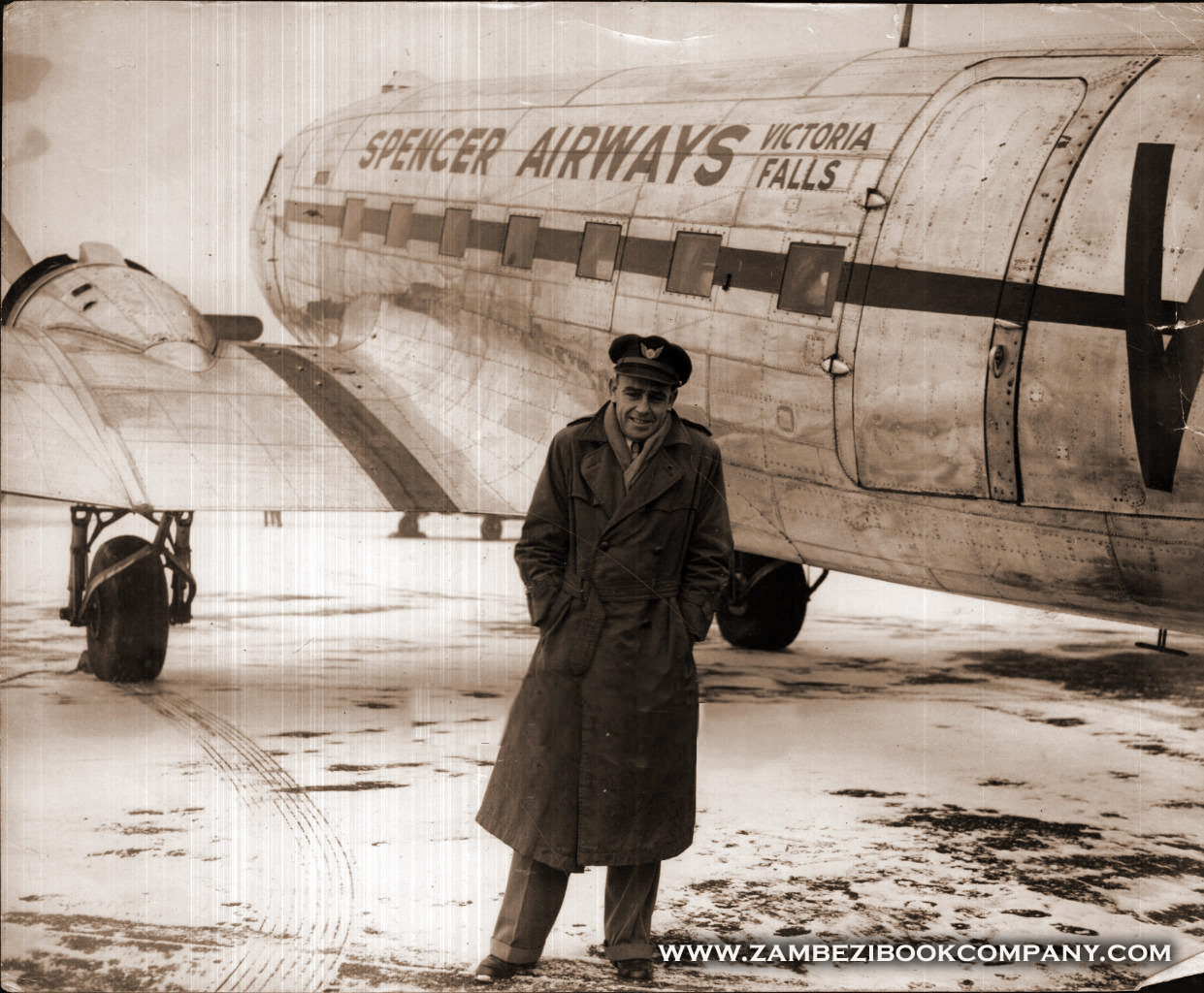
Towards the end of the War Spencer's Airways, Victoria Falls, were using one Avro Anson, one de Havilland Fox Moth, one Tiger Moth and one Fairchild UC.61A to provide short pleasure flights over the Falls.
Whitehead also records that Spencer had hoped to establish a flying boat service to Barotseland after the war, but he died tragically in a crash in London in 1947. An advert in Flight Magazine, 16th January 1947 records Spencer offering free passage from London for 16 married service men looking to emigrate to Rhodesia (Flight Magazine, Jan 1947). Spencer was piloting the Dakota plane which stalled and crashed soon after take off from London on the 25th January with 18 passengers, eleven of who also sadly died (Flight Magazine, July 1947).
Ted Spencer at Croydon Airport, 1947
Ted Spencer’s nephew, Terrance, took over the family business.
“His nephew, Terry, [who] took over the mantle of chief aviator for Spencer’s Airways, had beat the odds flying a Lancaster through most of World War Two. His luck ran out almost two years after his uncle’s. On 20 October 1948, whilst on a game flight, his plane caught fire somewhere over the Katambora Rapids. Turning for home on a burning wing and a prayer, Terry Spencer coaxed the Fairchild back towards Victoria Falls. Never made it. Crashed amongst the horizon-to-horizon teak forests... on the remote Westwood Farm. It was a long time, six weeks to the day, from the wristwatches of the crash victims, before the wreckage was found.” (Meadows, 2000)