To The Victoria Falls
Development of the Railway
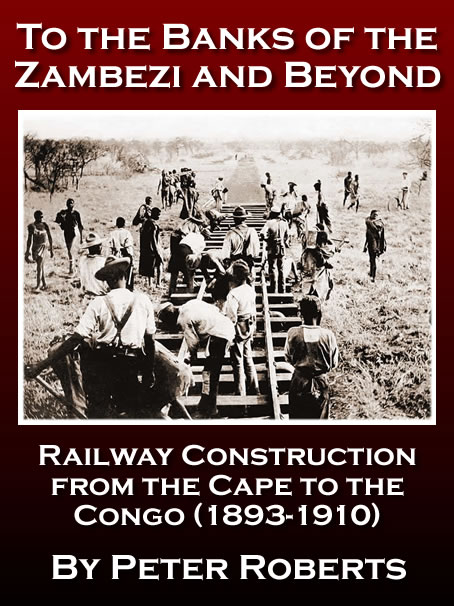
The following text is adapted from 'To The Banks of the Zambezi and Beyond - Railway Construction from the Cape to the Congo (1893-1910)', researched and written by Peter Roberts and first published in 2021. Please visit the Zambezi Book Company website for more information.
Rail, Rinderpest and Rebellion
Construction of the northward extension of the railway from Mafeking, initially to Gaberones and then Mochudi, a distance of 123 miles (198 km), began late in 1895 and eventually opened to traffic on 1st March 1897.
"A provisional contract has recently been entered into between the Government of British Bechunaland, the British South Africa Company, and the Bechuanaland Railway Company, providing for an extension of the line from Mafeking to Gaberones in the first instance, about 100 miles [161 km], and thence subsequently towards Palapye, a further distance of about 200 miles [322 km]. Towards the construction of these sections northwards to Bulawayo the Imperial Government gives a grant of £200,000, spread over a period of twenty years, and the Chartered Company has also agreed to pay the Railway Company £5,000 per annum for ten years, when the line reaches Gaberones and another £5,000 per annum for the same period on it being finished near Palapye." (British South Africa Company, 1894)
Early construction appears to have been at a rather leisurely pace.
"The construction of the line north of Mafeking was to some extent hindered by agricultural considerations. Some chiefs refused to allow the track to be laid across their vegetable gardens, so detours had to be devised, Khama insisted that gates be provided at strategic points to enable him to move his cattle from one part of his territory to another across the railway strip. At times the engineers wondered if the line would ever be completed." (Rhodesia Railways Magazine, December 1959)
Early February found Rhodes leaving London on route to Beira and then Bulawayo, unaware of the challenges which lay ahead for his embryonic territory.
"By the end of February 1896 things looked more hopeful, the survey to Palapye having been completed and the opening of the line for traffic through to Gaberones by July being forecast."(Bolze, 1968)
Curse of the Rinderpest
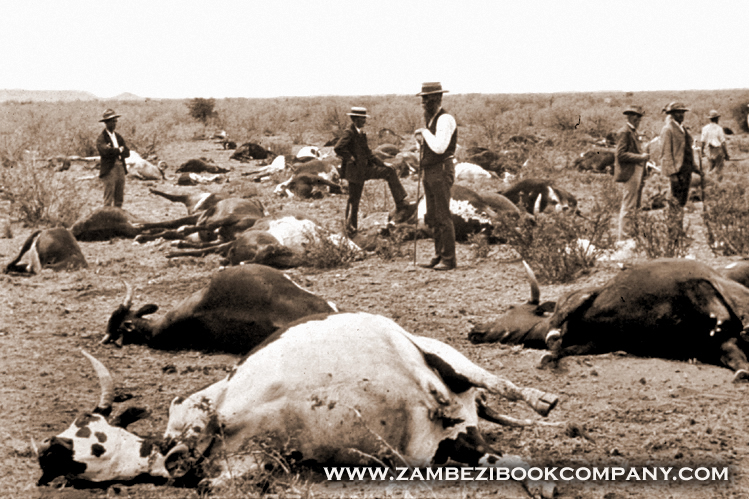
In 1887, the rinderpest virus, a cattle plague from central Asia, was accidentally imported in to Africa in livestock brought by an Italian expeditionary force to Eritrea. It spread rapidly, reaching Ethiopia by 1888, the Atlantic coast by 1892 and South Africa by 1897. With no native immunity, the outbreak killed an estimated 80 to 90 percent of all cattle in southern Africa - some five and a half million animals. The pandemic coincided with a period of drought, causing widespread famine.
Results of the Rinderpest 1896
The new settlement of Bulawayo was already under increasing pressure when, in addition to droughts and crop failure, the rinderpest reached the territory in early 1896, killing cattle and stopping all forms of animal-drawn transport - driving transportation charges between Mafeking and Bulawayo as high as £200 a ton.
"The rinderpest, which for several years has been devastating Africa, travelling slowly through the continent from north to south, make its first appearance in Matabeleland in February 1896, and energetic measures were at once taken to stamp out the disease...
"The effects of the disease have been far reaching and, apart from the considerations of human life, have been ore disastrous than those of the native rebellion. The ox-wagon transport upon which the country was formerly dependent for its supplies was entirely destroyed, and had to be replaced by imported mule transport. The necessities of life reached famine prices." (British South Africa Company, 1896/7)
George Pauling travelled by Zeederburg coach from Mafeking to Bulawayo during this period, later recalling:
"Shortly afterwards the outbreak of rinderpest amongst the cattle of the country created great difficulty in transporting into Matabeland even the necessities of life, and the extension of the railway to Bulawayo was urgently wanted... I went as far as Mafeking by rail, and from there had a special coach to take me to Bulawayo. The journey, which took us nine days to accomplish, was a terrible one. At every coach station and frequently along the road the stench from the unburied bodies of cattle, which had died from the rinderpest, was awful, and two or three times I was physically sick from the nauseating odour which one seemed not only to smell, but to inhale."
Pauling estimated that at least two million cattle died in Mashonaland, Matabeleland and Bechuanaland during the rinderpest outbreak.
"Owing to insufficient knowledge of it nothing could be done to eradicate the disease, although all kinds of remedies were tried. Ultimately it practically wiped out the cattle and most of the game in Mashonaland, Matabeleland, and Bechuanaland; and although, as it got further south, it decreased in violence, and more effective remedies were applied, at least 2,000,000 head of cattle must have died in these three territories alone from the disease." (Pauling, 1926)
During the rinderpest outbreak Zeederberg experimented with using zebra, but found them poor in stamina and, not surprisingly perhaps, not up to the work.
Rebellion Rises
Seizing on the vulnerability of the isolated and struggling settlers in Rhodesia, the Matabele Rebellion flared up in late March 1896. News reports recorded the first skirmishes.
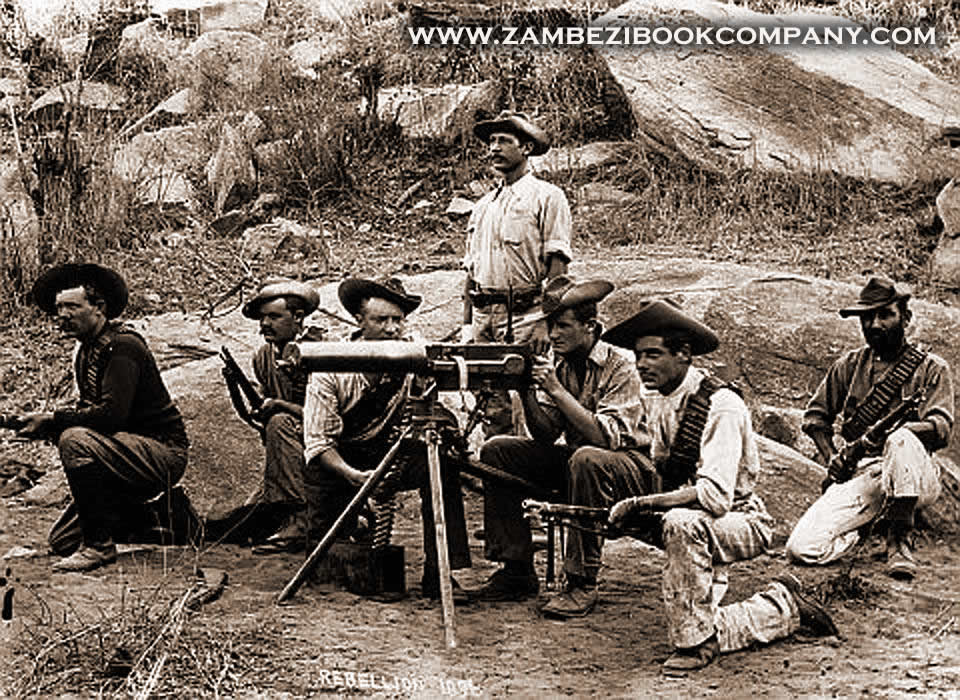
"March 27th. Further cablegrams from South Africa state that the Matabele natives at the Matoppo Hills made a descent upon the white settlers in the vicinity, and massacred a number of the latter, including Mr Bentley, the native commissioner... A force, consisting of 100 volunteers, with Maxim guns, has been despatched from Buluwayo, the capital of Matabeleland, to avenge the massacre, and to protect the settlers in the neighbourhood of the Matoppo Hills. The settlers are greatly alarmed in consequence of the Matabele rising, and numbers are flocking into Bulawayo for safety. The Matabeles made a raid upon the farm of Mr Selous, the famous South African hunter and explorer." (The Goulburn Evening Post, March 1896)
Matabeleland Relief Force Maxim Detatchment
(photograph by William Rausch)
It was reported that the whole area surrounding Bulawayo was in revolt, with an estimated 8,000 Matabele massing in the Matobo Hills. During the Rebellion, wagons and mail coaches were the sole means of transportation to European settlement at Bulawayo. George Pauling recorded:
"As the coach approached the Matoppo Hills, the stronghold of the Matabele, the Matabele rebellion having broken out, we travelled during the night as quietly as we possibly could in order to avoid being attacked by the rebels. We could see their fires on the hills, but although the prospect was disquieting, no attempt was made to stop us." (Pauling, 1926)
It was not, however, always the case.
"One coach, with nine passengers, was attacked in a running fight between Shangani and Bulawayo. The mules were eventually run to a standstill and were killed. The driver and passengers ran to the top of a nearby kopje and prepared to defend themselves. With night coming on their situation was bad, but they were saved by the timely arrival of a patrol under Col. Napier on its way to Gwelo. The coach, however, had been burned to ashes." (Rhodesia Calls Magazine, 1973)
The troubles would continue for several months until peace was negotiated by Rhodes himself in August 1896.
Pressures to Progress
Back in London the Directors appeared content with progress and confident that the immediate target of Gaberones would be reached by July 1896.
"At their meeting held in London on the 21st May, 1896, the Directors of the Bechuanaland Railway Co Ltd reported a satisfactory increase in the receipts of the Vryburg-Mafeking line which was grossing of the order of £2,600 and netting some £1,500 a month. They expressed confidence in the belief that traffic in the future would show further considerable augmentation with the development of Rhodesia. They noted that the 100 mile [161 km] extension of the line northwards from Mafeking had been put in hand and that the contractors had made excellent progress. Material for a further 100 miles [161 km] of line had already been ordered and the contract for the construction of 25 miles [40 km] of this section had just been concluded. However, Mafeking was to remain the railhead for 21 months, i.e. until July 1896, when Gaberones was reached by rail." (Bolze, 1968)
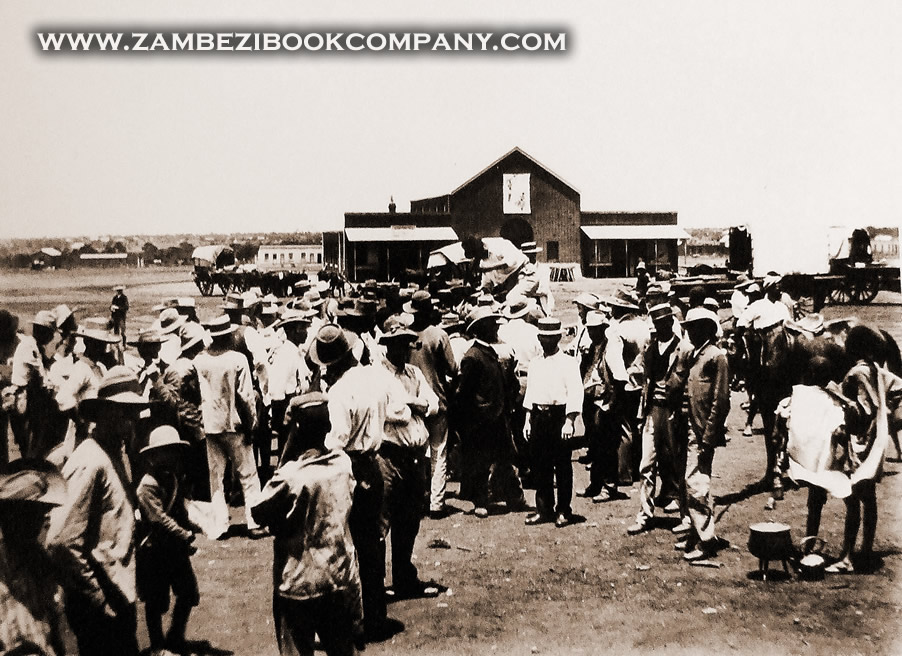
Bulawayo Market Square 1895
The settlers and traders of Bulawayo, however, were less enthusiastic on progress.
"By the end of May [1896] concern was being expressed over the possible rise in the price of wagon transport which was forecast at £5 or £6 per hundredweight, and a suggestion was put forward that traction engines be used for draft purposes. A leading article of 3rd June was indicative of the testy mood of Bulawayans:
"‘We are glad that our continuous advocacy of the necessity of rapid railway construction has borne fruit, and the combined action of the Chamber of Commerce and the Chamber of Mines will have a great influence upon Mr Rhodes. As Mr Scott pointed out at the meeting, the rate construction which has been followed with the extension beyond Mafeking is almost disgraceful - 45 miles [72.5 km] in about 9 months - and it would take about 8 years before the railway reached Bulawayo at the same rate of laying down the rails. Mr Redrup suggested that Mr Rhodes be asked to start the earthworks at this end so as to give employment to a number of men and to expedite operations.’" (Bolze, 1968)
In early August 1896 a correspondent for the Cape Times records business in Bulawayo at a standstill and food and supplies scarce.
"Of course, nearly all business, excepting that done by store and canteen keepers, is at a standstill. The butchers’ shops have been closed for some days. When they are again opened it will be worth a Photographer’s while to be on the spot. Food is coming up, I am told, but it cannot come too quickly. Men with ready-money in their hands have been refused meals at eating houses during the past week, and but the other day a friend decoyed me into a restaurant where he assured me we could obtain a cheap meal. Three of us sat down, and each had two tiny eggs, two thin rashers of pork, a spoonful of tinned peas, and a piece of butterless bread. One bottle of beer was divided between us. At the close of the feast 25s a head was charged. It is little wonder therefore that all those who can possibly do so are leaving for the south until affairs are straightened up. A man can at present live comfortably in the colony for a week for a sum on which he would exist miserably in Bulawayo 48 hours.
"And yet with all this the prices of Bulawayo stands remain as firm as ever. Several outside stands were put up at auction on Saturday evening at the Maxim Hotel half of which fetched prices fully as high as they would have done six months ago. The bidding for the remainder not being brisk, the owners refused to sell at anything like a sacrifice. This certainly shows an unshaken faith in the future. Many of our citizens are firmly convinced that before the advent of the railway real estate will have doubled in value. Neither rebellion nor rinderpest can lessen the richness of the reefs, nor can they alter the fact that Matabeleland has a fine climate and a fruitful soil."(The Sydney Morning Herald, August 1896)
|
References
Bolze, L. W. (1968) The Railway comes to Bulawayo. Rhodesiana, No.18, July 1968, p.47-84.
British South Africa Company (1894) Directors Report and Accounts. 31st March
1894.
British South Africa Company (1896/7) Directors Report and Accounts. 31st March 1896/7.
Pauling, G. (1926) Chronicles of a Contractor
Rhodesia Calls Magazine (1973) How ‘Wild West’ coaches opened up Rhodesia. White, P. J. May-June 1973.
Rhodesia Railways Magazine (December 1959) The South Line - Boer War Reminiscences. Vol.8, No.8, p.29. [BRMA]
The Goulburn Evening Penny Post (March 1896) Matabeleland. 28th March 1896.
The Sydney Morning Herald (August 1896) A Bulawayo Budget. 5th August 1896.
Further Reading
Roberts, P. (2021) To The Banks of the Zambezi and Beyond Railway Construction from the Cape to the Congo (1893-1910). Zambezi Book Company.
|

|
Search www.tothevictoriafalls.com:
|
'To The Victoria Falls' aims to bring you the wonder of the Victoria Falls through a look at its natural and human history.
This website has been developed using information researched from a wide variety of sources, including books, magazines and websites etc too numerous to mention or credit individually, although many key references are identified on our References page. Many of the images contained in this website have been sourced from old photographic postcards and publications and no infringement of copyright is intended. We warmly welcome any donations of photographs or information to this website.
 Website text © Copyright Peter Roberts 2012, All Rights Reserved.
Webpage design by EcoElements Digital Media Solutions
|