To The Victoria Falls
Photographers
William Rausch (1864-1900)
Johannes Heinrich Wilhelm (John Henry William) Rausch was born on 26th July 1864 at King Williams Town (now Qonce) in the then Cape Colony (South Africa). He married Emily Eliza Cumpper (born in 1865 in Camden Town, London) in Islington, London in 1890. Their only son, Frederick William, was born on 3rd April 1891 in Hackney, London.
By 1895 the family had relocated to Bulawayo, with William soon establishing a studio in Bulawayo at 183 Abercorn Street, opposite the Bank of Africa, an advert promoting "All kinds of photographic work undertaken - groups photographed in town or country" (Bulawayo Sketch, 21st November 1896). He also offered for sale 'native' portraits, photographic Christmas cards and albums depicting the principal streets and buildings of Bulawayo.
Rausch is known for his photographs of Bulawayo, the Second Matabele War (1896-7, also known as the Matabele Rebellion) and the Second Anglo-Boer War (1899-1902). He also visited the Victoria Falls in 1898, producing one of the earliest known sets of commercially available photographs of the Falls.
Rausch often titled and signed his photographs, although a handful are known signed but untitled, and many are known with no title or credit. Rausch often also numbered his images - although about half known examples are un-numbered.
Rausch appears to have used two sequences of numbers to catalogue his photographs. His first series appear to be numbered, presumably from 1, upwards to 305 or higher. These cover the period of his arrival at Bulawayo in 1894 to new year 1898/9. The earliest known numbered photograph (14), shows a native village scene.
The second series relates to his Boer War photographs and are numbered from 1000 upwards, the highest known number being 1156.
Native Village Scene (14) William Rausch
Matabele Rebellion (1896-7)
Rausch's photographs document events in and around Bulawayo during the Matabele Rebellion (1896-7), showing defensive laagers with the town and nearby forts (including Halstead and Umlugulu), troops (including the mounted 7th Hussars and Gifford's Horse) and groups of prisoners. Many of these photographs are un-numbered.
A regular advert placed in the Bulawayo Chronicle from May 1896 promoted:
"A large and Choice Selection of Scenes of the present crisis; also Views of the Laager and different parts of the Town. Photographs taken at the Studio will be executed with despatch. Abercorn Street, opposite Bank of Africa." (Bulawayo Chronicle, 2nd May 1896)
A new advert, from October, announced "New Photographs Ready - Col. Plumber's Camp at the Matopas, Mr Rhodes Camp and Indaba. All the Forts from Bulawayo to Mangwe." (Bulawayo Chronicle, 3rd October 1896)
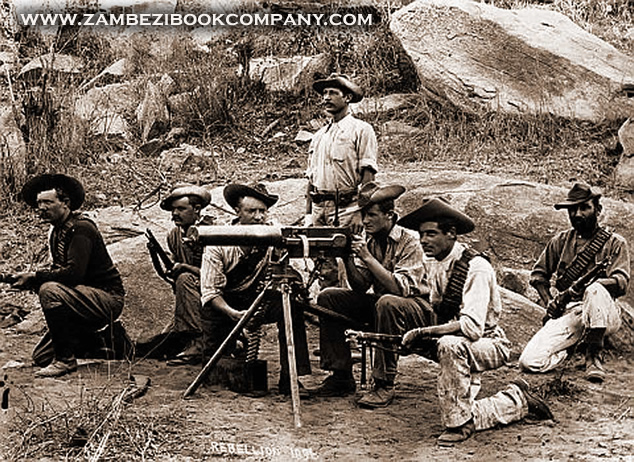
Matabeleland Relief Force Maxim Detachment, 1896 (un-numbered) William Rausch
Read more: Rail, Rinderpest and Rebellion
Arrival of Railway, Bulawayo (1897)
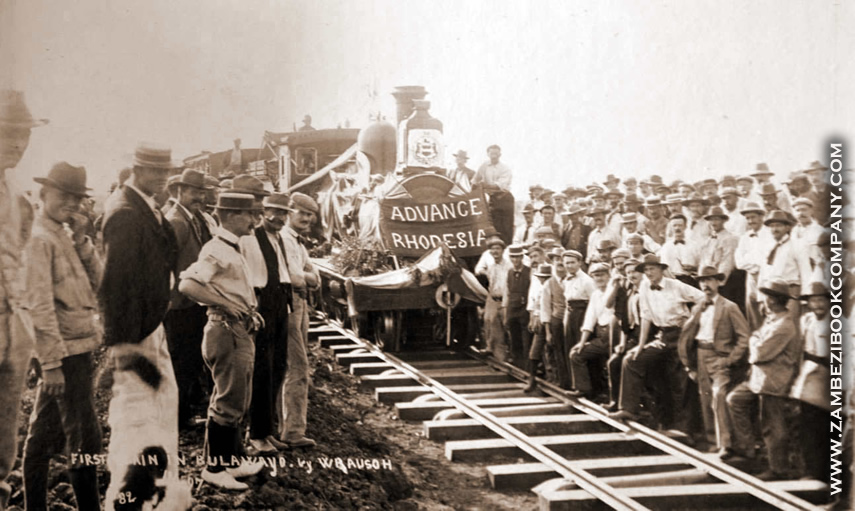
Rausch is present for the arrival of the first construction train at Bulawayo in October 1897 and the official opening in November 1897, when he hires the services of another newly arrived photographer, Louis Pedrotti.
"We notice that Mr W Rausch does not intend to be left behind during the Festivities and that in order to meet the demand for photographs of native scenes and buildings in and around Bulawayo has secured the services of Mr and Mrs Pedrotti, who have recently arrived from Wimbledon. Those of our visitors who desire to retain some permanent memories of their stay in Matabeleland, cannot do better than pay Mr Rausch a visit." (Bulawayo Chronicle, 4th November 1897)
Arrival of first train, Bulawayo, October 1897 (82) William Rausch
At least three photographs are known from the arrival of the first train in October (one numbered 82), and another three from the official opening in November 1897.
Two photographs of trains crossing the temporary tracks over the Shashi River (un-numbered) also date from this period (the permanent bridge was constructed late 1898).
Crossing the Shashi River, 1897 (un-numbered) William Rausch
Read more: Bulawayo or Bust
The Victoria Falls (1898)
Rausch visited the Falls in the second half of 1898 and was back in Bulawayo promoting his new photographs of the Falls by late October.
“Who does not wish to visit the Victoria Falls, and to look upon what Livingstone called the grandest wonder in the world? But everyone cannot spare the time to traverse the two hundred and fifty miles, and in the case of people in England, the eight thousand odd, which separate them from one of the greatest natural cascades in existence. The next best thing to seeing them for oneself is to have photographs of the famous Falls, and Mr W Rausch is prepared to supply that want. He has produced an excellent collection of pictures of the Zambesi and the Falls and has them in various sizes, even in the reduced size available for Christmas Cards. The photos give views of the renowned Falls from every position, as well as glimpses of Zambesi scenery and Zambesi inhabitants, and therefore are a panorama of that part of Africa. We feel sure that ‘exiles from home’ could not please their friends more than by sending them a selection of these photographs, and we may safely predict a large sale. Mr Rausch is located in Abercorn Street next to Sauer’s Chambers, where the views can be inspected.” (Bulawayo Chronicle, 22nd October 1898)

Victoria Falls, 1898 (un-numbered) William Rausch
At least 14 photographs of the Falls are known, including 8 views of the Falls (including numbers 171, 177 and 216) and 4 of vegetation scenes (including numbers 201 and 208).
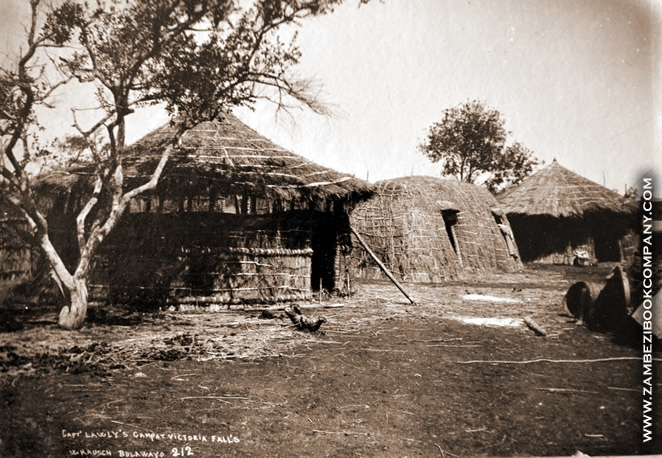
An image of Captain Lawley's Camp at the Falls (212) was also taken on this trip. Lawley visited the Falls in June 1898.
Captain Lawley's Camp, Victoria Falls, 1898 (212) William Rausch
Read more: North of the River
The War Dance (1898/9)
A series of photographs, dating from New Year's Eve 1898/9, showing a native ceremony featuring Gambo, one of Lobengula's former councillors and a prominent figure after Lobengula's defeat. Gambo is also featured in earlier images, including one during the Rebellion (un-numbered) and two later photographs (128 and 150 - which look to have been taken at the same time despite the gap between numbers, estimated to be 1898).
The photographs feature a traditional war dance (258) and ceremonial beer after the ceremony (bearing earlier numbers, 252 and 254, the latter dated to "New Year 1899"), and another numbered 305. These are the latest known photographs in Raush's 'general series'.
"The War Dance at Spring's Farm. A large exodus of Bulawayans took place early Wednesday morning, their destination being the scene of the war dance, in which it was expected several thousand natives might take part. The town was almost entirely denuded of vehicles and horses. About two hundred townsmen attended, and amongst those present were the Administrator, Capt. the Hon. Arthur Lawley, Mrs Lawley, Lady Decies, the Hon. Miss Beresford, Capt. Carden, Capt. Jesse-Coope, Mr H J Taylor, CNC, Mr J Mullins and others.
"The proceedings began about 11.30 with a dance by intombis. The different impis under their respective indunas then approached from various quarters and combined to execute the usual war dance. About two o'clock beer was served out to the natives by the indunas, after which some more evolutions by the natives took place before Captain Lawley. A dozen cattle were then shot to serve as meat, being a present to the natives from the Government. Soon after this the proceedings terminated. About 3,000 natives, it is estimated, were engaged in the event." (Bulawayo Chronicle, 7th January 1899)
The War Dance, December 1899 (258) William Rausch
Second Anglo-Boer War (1899-1902)
Raush's photographs document events relating to the early stages of the Second Anglo-Boer War (1899-1902) with photographs showing the arrival of Queenslander and Canadian troops at Bulawayo, armoured trains and trucks, defensive positions (Crocodile Pools) and group troop portraits (E, F, and G).
Photographs of the Boer War appear to be numbered in a different sequence from 1,000 upwards, the highest known number currently being 1156. These photographs date from 1899-1900.
Armoured Train (1019) William Rausch
Another two photographs (1152 and 1156) show the New South Wales Imperial Bushmen departing Bulawayo and date from April/May 1900.
New Studio (December 1899)
In late 1899 Rausch moves to new a new premises in 7th Avenue.
"Mr Rausch's Studio - It was a happy thought on the part of Mr W Rausch to signalise the removal of his business to new and more commodious premises in 7th Avenue by arranging an exhibition of views which are illustrative of Rhodesia since the beginning of its history. Among the hundreds of pictures shown are ones that will appear to every member of the community, and many of them would be extremely interesting to friends at home. There are photos of Matabele of all sorts and sizes, of pioneers, prospectors, searchers of ancients mines, kafir kraals, rivers, railways, groups of officers and men who did splendid service before and during the rebellion, indabas, natives commissioners, intombis, and white folk of various degrees of distinction, to say nothing of many representations of Rhodesian scenery and a 100 and 1 other things. The proceeds of this unique exhibition which embraces everything from the Zambesi to the Limpopo, Mr Rausch intends to devote to the Free Lunch Fund, and we wish him every success. His studio will well repay a visit." (Bulawayo Chronicle, 9th Dec 1899)
An accompanying advert listed:
"The Premier Studio Grand Photographic Exhibition, 7th Avenue, near Post Office, In Aid of the Free Lunch Fund. W Rausch, Photographer, has removed to larger and more convenient premises in 7th Avenues (Opposite W. Ramsay, Ironmonger) where he has arranged an Exhibition of Photographs, showing the History of Rhodesia for nearly five years. Nearly 1,000 Prints are on Exhibition. The Studio is large enough to accommodate groups of thirty." (Bulawayo Chronicle, 9th December 1899)
Death (September 1900)
Rausch died of pneumonia on 23rd September 1900 at the Bulawayo Memorial Hospital, aged just 38 and leaving a widow, Emily, and young son, Frederick William (aged just 9).
H A de Beers was appointed as executor and his estate was finalised 24 January 1901. From the low number of creditors and debtors it has been suggested that Rausch’s photography business was struggling at the time of his death.
"At the time of his death his business does not appear to have been prospering, as little or nothing was due to him by his customers; at the same time he owed two chemists (B G Lennon & Co and Smart & Copley) about £50, from whom he presumably got his photographic supplies. His wife and son were left with about £10." (unknown typed reference)
In contrast it is now thought likely that during the period of his illness Rausch was able to finalise much of his business affairs, and that in fact Rausch was a highly successful and prolific photographer with a large catalogue of work at the time his early death.
Following his death it is believed that the family continued to sell prints from Rausch's extensive catalogue, including licensing their use by several postcard publishers.
Postcards
After his death three of Rausch's photographs appeared in a series of postcards produced by Percy M Clark and credited to Samuel C Turner, titled 'Crocodile', 'Crossing a Drift' and 'Skoff Time'. Other publishers, including R. Fuesslein, are also known to have used Rausch's photographs.
Crossing the drift at the Umzingwane River on the old Tuli-Bulawayo Zeederberg Coach road, William Rausch, from a postcard produced by Percy M Clark
The Auctioned Albums
A portfolio of over 450 of Rausch's photographic prints sold for £5,400 in 2017 (Dominic Winter, 2017), and another group of over 300 photographs sold at Bonhams in 2019 for £3,750 (Bonhams, 2019).
The auction description of the 2017 album gives an indication of some of the subjects and number of different images. The album was perhaps Rausch's catalogue of his photographs, available for customers to browse in his studio.
"An over-size photograph album, circa 1896-1900, containing approximately 470 mounted gelatin silver prints by W. Rausch of Bulawayo, from the time of the Second Matabele War to the Boer War, mostly signed, captioned and numbered in the negative, subjects include a hanging scene, numerous ethnographic studies, some in studios but mostly in natural settings, Laager, market and camp scenes, first train in Bulawayo, ruins, street scenes, river scenes, first contingent of Queenslanders and Canadians in Bulawayo, Queen's birthday salute, cycle parade, South & Rhodesia volunteers to the front, Victoria Falls, various troops including cyclists, the majority approximately 15 x 20 cm and mounted four to a page and back to back on stiff card leaves, but including 9 larger format (28 x 35 cm) and 16 smaller, partly broken and many leaves detached, contemporary cloth, old leather reback, some wear, oblong folio. Please note that this album weighs 16.5 kgs." (Dominic Winter, 2017)

Photographs from the album auctioned in 2017, William Rausch
The 2019 auction also indicates some of the images:
"Album of upwards of 300 photographs by W. Bausch, of Bulawayo of daily life, landscapes, ancient ruins, dam and rail construction, mining and trading in Rhodesia (modern-day Zimbabwe), and the preparations of troops involved in the Second Matabele War. Images include: Gambo's Kraal, Indaba Government House, "First Train in Bulawayo", Regina ruins (12), "W[h]irlwind, Bulawayo" (5), train crossing the Sashi river (2), Mattopo Hills (c.30), Mattopo Dam (8), "Capt. Lawly's Camp at Victoria Falls" and others at Falls (c.25), Geelong, Zambesi River, Seebamam village (4), "Store at Inzisa River" (2), "First Contingent of Queenslanders and Canadians in Bulawayo" (4), Armoured engines and trains (8), Fort Gaberong and Crocodile Pools (c.10), Mafeking Day at Bulawayo (c.12, including 3 of a cycling race), "Impr Bushman Camp at Bulawayo" (c.20), "Antenior Mine Gwanda [and Geelong]" (4), Bulawayo buildings and streets (8), and others of towns, industries, transport, military operations, and scenery in Rhodesia/Zimbabwe." (Bonhams, 2019)
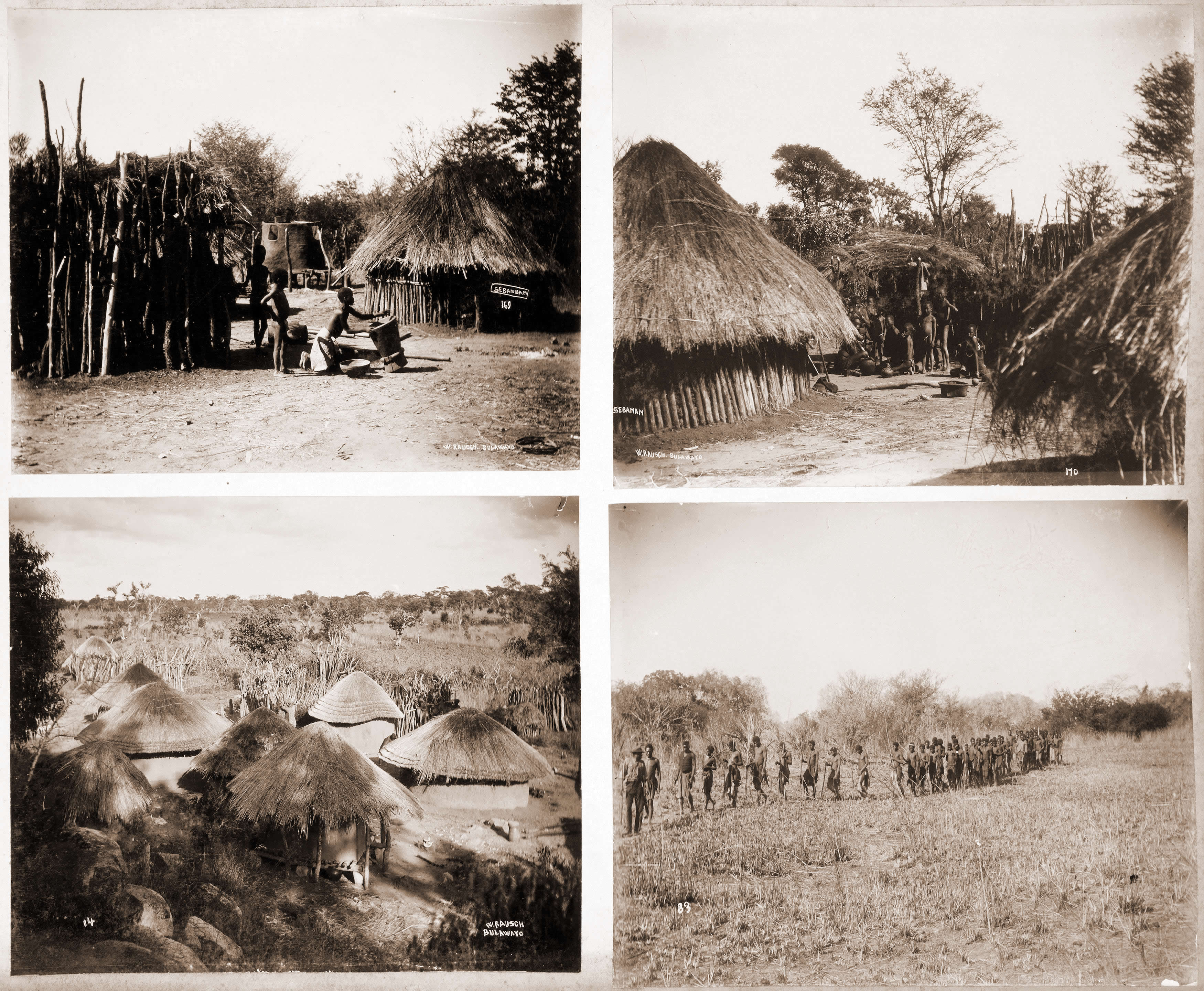
Photographs from the album auctioned in 2019, William Rausch
Further Information
William Rausch - Rhodesia Study Circle
Dominic Winter (2017) William Rausch photograph album, circa 1896-1900. Lot 416.
Bonhams (2019) Album of approximately 300 photographic views and scenes of Zimbabwe (c.1896-1900). Lot 144.