To The Victoria Falls
Development of the Victoria Falls
The following text is adapted from 'Footsteps Through Time - A History of Travel and Tourism to the Victoria Falls', researched and written by Peter Roberts and published in 2017. Please visit the Zambezi Book Company website for more information.
War and Peace
During the period of the First World War (1914-8) the Falls Bridge was a strategically important transport link for the movement of British South Africa Police and Rhodesian troops - and a potential target for German saboteurs, with German South West Africa (now Namibia) only 80 kilometres away. To prevent attack the Bridge was defended with a military guard, consisting of two officers, ten European rank and file from the British South Africa Police and fifty armed native police from Southern and Northern Rhodesia, supported with two mounted Maxim recoil-operated machine guns.
“As soon as war was declared the combined detachment of both British South Africa Police and Northern Rhodesian Police under Major A E Capell D.S.C, B.S.A.P, at the Victoria Falls Bridge was instructed to guard the railway Bridge and to patrol both banks of the Zambezi River above the Bridge. Blockhouses were erected and an electric light plant supplied at the bridge, and an observation post consisting of one officer and twenty-five men was placed at Kazungula, on the Zambezi River, fifty miles [80.5 km] west of Victoria Falls.” (Brelsford, 1954)
Mounted Patrol crossing over Victoria Falls Bridge.
A reinforced concrete watchtower commanded a view of the Bridge and a rail-mounted mobile searchlight shunted back and forth along the Bridge, until finally it was decided to position it off the Bridge, from where it could light up the entire structure.
“The second track was used on several occasions to site the searchlight correctly and... was no easy task. The searchlight was mounted on a bogie truck which was moved from one position to another both on and off the bridge before the authorities were satisfied. Finally it was parked on the south bank, in the vicinity of the Rain Forest, and from this point it was able to command not only the approaches but almost the entire bridge itself even down to the foundations.” (Rhodesia Railways Magazine, May 1964)
Conflict in the Caprivi
Upstream of the Falls British and German interests came into direct contact through the Caprivi Strip, ceded by the British in 1890 and connecting German controlled South West Africa with the Zambezi. In 1909 the Germans established an administrative base at Schuckmannsburg (renamed Luhonono in 2013), opposite Old Sesheke. With the outbreak of war in Europe this isolated outpost suddenly became of significant strategic importance to both sides.
“In September, 1914, it was decided that the occupation of Schuckmannsburg, the German post in the Caprivi Zipfel opposite Sesheke on the Zambesi River, would allay considerable apprehension amongst the native tribes in the British territory, and would safeguard the trade routes on the river. Schuckmannsburg was occupied without resistance on the 21st September by Major Capell, who had moved his joint Southern and Northern Rhodesian detachment from Victoria Falls to Sesheke for this purpose. The German resident and his European police subordinate were made prisoners of war and a Commissioner for the Bechunaland Police Force put in charge of the station.” (Brelsford, 1954)
The Lion of Africa
The main threat to British territories in southern Africa came from a small German unit under the command of Lieutenant Colonel Paul von Lettow-Vorbeck, known as the German ‘Lion of Africa.’ Stationed in German East Africa (now Burundi, Rwanda and mainland Tanzania), he ignored defensive orders from Berlin and the colony’s governor, embarking instead on a determined offensive guerrilla operation to disrupt and attack British activities.
Von Lettow-Vorbeck avoided direct engagements with British forces, instead directing his men to engage in raids into British East Africa (now Kenya), the British Protectorate of Uganda, Northern Rhodesia and Nyasaland (now Malawi), targeting forts, railways and communications. It was only on the 14th November 1918, three days after the official surrender of German forces, that von Lettow-Vorbeck was informed of the armistice and agreed to a cease-fire at the spot now marked by the Von Lettow-Vorbeck Memorial in present-day Zambia. Essentially undefeated in the field, the now General von Lettow-Vorbeck was the only German commander to successfully penetrate British overseas territory during the War.
One old hand who did not live to see the end of the War was Captain Frederick Courteney Selous, D.S.O, who had signed up to the 25th Royal Fusillers in 1914 at the age of 64. He was killed by a German sniper on 4th January 1917 in what is now the Selous Game Reserve (Tanzania). A simple stone and bronze plaque marks his grave. His eldest son, Captain F H B Selous, was reported missing in action, and later reported killed, a year to the day later, on 4th January 1918.
Global Influenza Pandemic
The global influenza pandemic of 1918-20, known as Spanish flu or the ‘forgotten pandemic,’ infected an estimated 500 million people across the world, from isolated Pacific islands to the remote Arctic fringes, claiming over 50 million lives - more than the number lost in the First World War and making it one of the deadliest natural disasters in recent human history.
The pandemic reached Southern Rhodesia in October 1918, affecting the whole country, particularly the high-density mining communities. Percy Clark recalled:
“The epidemic spread like wildfire through the country, treating white and black folk alike, taking toll of all. Victoria Falls suffered with the other towns and settlements, For a fortnight not one train arrived from Bulawayo, there being neither engine-drivers nor firemen to man the engines. We were isolated from the rest of the world. No provisions or vegetables came in from the south. Livingstone was in a like predicament... At the Falls we had scarcely one well person. At the hotel, for example, the only person afoot of visitors and staff was the housekeeper. I was the only one in our household who was not down with the malady, and the sick included all our native servants, so that I had to look after all the invalids myself... At one time my wife and younger son were not expected to live...
"When the epidemic was at its worst I had a visit from the hotel housekeeper. She came to me with the request that I would make chicken broth for the visitors and staff of the hotel who were down with flu. The request struck me as being a little thick, for the hotel had a big kitchen and one or two boys about on their feet, while I had my hands full as it was, with not a soul to help me. Still, I saw a funny side to the request, and the laugh did me good. I told the lady that if she would have the chickens sent over I would do the rest.” (Clark, 1936)
Back in England George Pauling was one of many who lost his life to the outbreak, succumbing to the disease on 10th February 1919 at the age of 64.
Return of the Liners
After the war the fashion slowly returned for luxury cruise liner trips to distant destinations. The Union Castle Line reintroduced the ‘Round Africa’ cruise service in October 1919 and during the early 1920s visitors to the Victoria Falls numbered around three thousand per year.
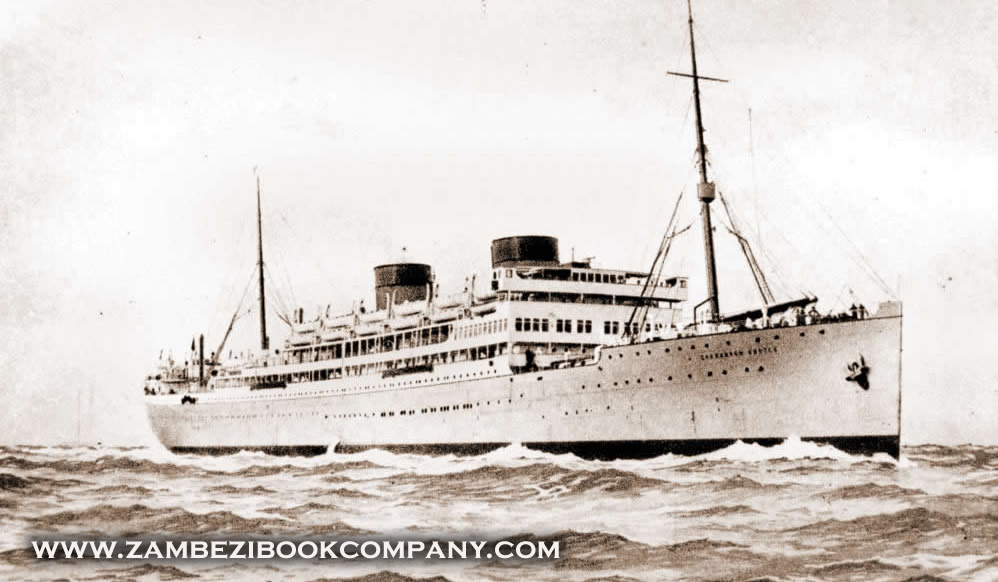
Many of the Union Castle line’s vessels had been requisitioned by the British government for national service as troop or hospital ships during the War, and eight were sunk by mines or German U-boats. During the late 1920s and early ‘30s Union Castle dominated the route with a new generation of 20,000-ton steam liners, including the ‘Carnarvon Castle,’ ‘Winchester Castle’ and ‘Warwick Castle,’ sailing weekly from Southampton to the Cape in only 14 days.
Union Castle Royal Mail Motor Vessle Carnarvon Castle.
In August 1923 a cenotaph was erected on the northern bank close to the Eastern Cataract, honouring the names of the men from Northern Rhodesia who lost their lives to the War. It was unveiled by His Royal Highness Prince Arthur of Connaught, grandson of Queen Victoria and Governor-General of the Union of South Africa (1920-4).