To The Victoria Falls
Development of the Railway
The following text is adapted from 'To The Banks of the Zambezi and Beyond - Railway Construction from the Cape to the Congo (1893-1910)', researched and written by Peter Roberts and first published in 2021. Please visit the Zambezi Book Company website for more information.
Early Development of the Cape System
The development of a railway in the southern Cape had first been proposed as early as 1828, and again in 1845, before actual construction finally began in 1857.
"The story of railway construction in Southern Africa is an integral part of the British expansion northwards. It is significant of their close relationship that the Cape Colonists, as early as 1845, talked about tapping the trade of the interior, the short line from Cape Town to Wellington from its inception being regarded as ‘the main trunk route of our interior trade.’" (Bolze, 1968)
Sir Charles Fox was consulting engineer and Mr William George Brounger chief engineer for the project, with E & J Pickering the contractor for the works.
"A contract was made by Sir George Grey, Governor of the Cape Colony, with the Cape Town Railway and Dock Company in December 1858 to make this line under a six percent guarantee from the Government... Sir Charles Fox was the consulting engineer of the company, William George Brounger was the engineer of the company in South Africa, and Edward Pickering was the contractor. The gauge was 4 ft. 8 in. [142.24 cm], and the weight of rails was 70 lbs. [31.75 kg] per lineal yard, and the cost was about £400,000." (Metcalfe, 1916)
Pickering turned out to be unreliable contractors, the first three miles of the construction taking two years. Slow progress, labour troubles and legal disputes continued until eventually the railway company itself completed the work under the direction of Mr William Brounger, the company’s chief engineer. The first section of railway line opened in February 1862, followed by Stellenbosch in May 1862 and Wellington in November 1863, covering a total 58 miles (93 kilometres).
"The first section, Cape Town to Eerste River, a distance of 21¼ miles [34.2 km], was opened for traffic on February 13th, 1862. This was the first railway of any importance in South Africa... The Cape line was completed to Stellenbosch on May 1st, 1862, and to Wellington on November 4th, 1863." (Hoy, 1923)
The potential for continuing the line north, all the way to the Zambezi River, was suggested as early as 1871. With an eye to future extension, the line was taken over by Cape Government in 1873 and converted to a 3 ft. 6 in. gauge.
"In 1869 the [Kimberley] Diamond-fields were discovered 650 miles [1,046 km] inland from Cape Town, and there was a rush to the Vaal River and to Kimberley in 1870. But there was evidently no conception on the part of the Cape Government of the great industry that would result from this discovery, for after purchasing the Cape Town and Wellington Railway, which was of the same gauge as we have in England, they converted it into a 3 ft. 6 in. [106.68 cm] gauge, which has unhappily remained until now the main line gauge in South Africa. This has been a great handicap to the trade and development of a country of great distances, as the speed on a 3 ft. 6 in. gauge is only half what it is on a 4 ft. 8 in. [142.24 cm] gauge." (Metcalfe, 1916)
By 1876 the line had been extended 64 miles (103 km) to Worcester, 122 miles (196 km) from the Cape. An extension of 229½ miles (369 km) saw the line reach Beaufort West in 1880, with the total distance from Cape Town then calculated as 337½ miles (543 km). Two further extensions, authorised in 1881, saw the railway extended 231½ miles (372.5 km) to the southern banks of the Orange River by 1884, 569 miles (915.5 km) from the Cape.
Diamond Diggers
The discovery of a single diamond in 1867, and more significantly, in 1869, a diamond which would eventually become known as the 'Star of South Africa' and rest among the British Crown Jewels, was a significant turning point for the developing Cape Colony.
However no-one knew where exactly to find the diamond fields, or how. Experts in the Cape suggested that they may not even be native to the region, or were even deposited by ostriches, which carried them in their gizzards. Why none had actually been found in the stomachs of dead ostriches was not so easily explained.
The subsequent prospecting rush, involving 10,000 of people, eventually became focused on a couple of Boer farm holdings in the region of the Orange river and the Vaal. In the middle of a dry pan on a farm, a strange yellowish crumbling clay was discovered to contain diamonds. Story has it a neighbouring farmhouse had been built using the clay. It was picked apart by pocket knifes. Nearby, the de Beer brothers de Beer, owned a dusty farm named Vooruitzicht ('Foresight'). They sold up for a staggering £6,000. Over the next twenty years it would yield more than £100 million in diamonds and become known to the world as Kimberley. It bothered no-one that the land where the diamonds were found came under neither British or Boer claims. However it was soon became part of the Cape Colony, with the Boers being compensated for their interests.
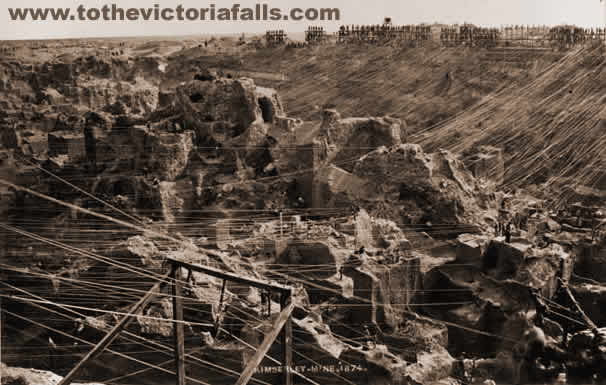
Kimberley Mines, 1874, showing aerial winding gear
The Rise of Rhodes
Cecil John Rhodes (1853-1902) arrived at the Cape Colony from England in September 1870 at the age of 17. After a short unsuccessful stint cotton farming, he followed his older brother Herbert to the newly discovered diamond fields in Kimberley, where he was to make his fortune.
In a letter to his mother, the young Cecil Rhodes described the diamond bearing soil:
"It works just like Stilton cheese, and is as much like the composition of Stilton cheese as anything I can compare to... They have been able to find no bottom yet..."
In the early days his average income was about £100 a week, far more profitable than his cotton-farming attempts, and becoming the foundations for a business empire that would make him the richest man alive.
Kimberley Mines (from Strage, 1973)
During the following decades Rhodes’ influence quickly grew to dominate the industry, founding the De Beers Consolidated Mining Company in 1888 and establishing a monopoly over diamond mining in the territory. Financed by this great wealth, Rhodes’ dreams and ambitions knew no limit. In 1877, at the age of 24, he had already shared his vision with his associates in Kimberley.
"The object of which I intend to devote my life is the defence and extension of the British Empire. I think that object a worthy one because the British Empire stands for the protection of all the inhabitants of a country in life, liberty, property, fair play and happiness and it is the greatest platform the world has ever seen for these purposes and for human enjoyment." (Rotberg, 1990)
After initial successes at Kimberley, Rhodes briefly returned to Oxford to complete his studies, becoming friends with Sir Charles Metcalfe (1853-1928), an engineer who in 1878 joined the London firm of Sir Douglas Fox and Partners and later travelled to South Africa as their consultant engineer for the developing Cape railway system.
Political Ambitions
In 1880 the Kimberley region had become incorporated into the growing Cape Colony and awarded six seats in its Parliament, one of which Cecil John Rhodes, put himself forward successfully as candidate in the Barkly West constituency.
One of his first projects upon election was to support the extension of the railway to Kimberley, now the second biggest settlement in the colony. Rhodes knew that further development of the mines would require heavy industrial equipment, and that a railway transport link was the key to success, not just for the people of Kimberley, but also his own expanding aspirations.
"Where else should any railway extension go than to Kimberley?" (Verschoyle, 1900)
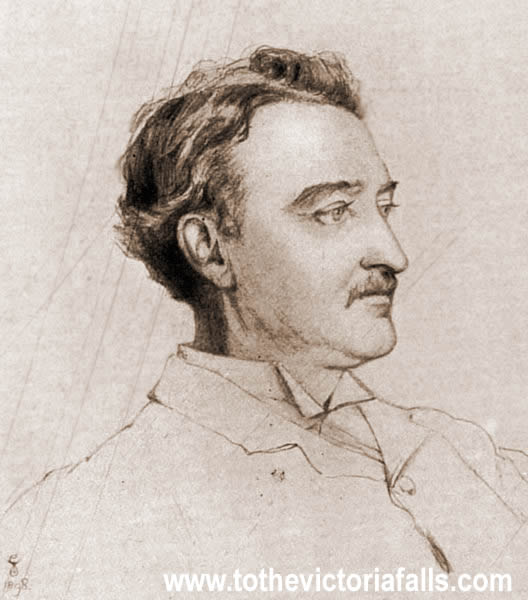
Cecil Rhodes drawn by Violet Manners