To The Victoria Falls
Development of the Railway
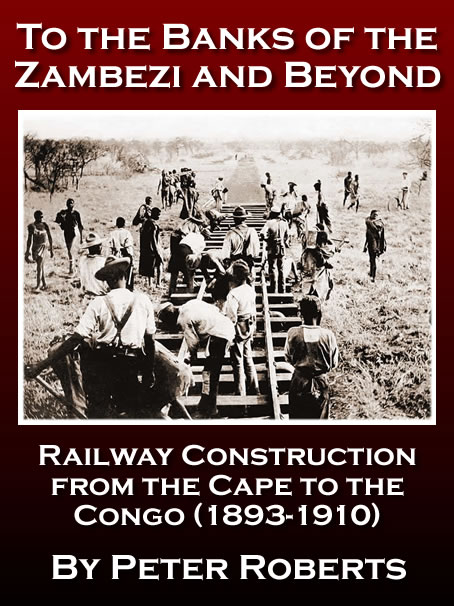
The following text is adapted from 'To The Banks of the Zambezi and Beyond - Railway Construction from the Cape to the Congo (1893-1910)', researched and written by Peter Roberts and first published in 2021. Please visit the Zambezi Book Company website for more information.
Cape to Cairo Railway
Railway Plans
In the early part of 1888, as politicians in the Cape debated the potential future route of the railway, a group of business investors, headed by Mr George Cawston and Lord Gifford, came forward with a proposal to extend the railway from Kimberley to Vryburg (then part of British Bechuanaland and incorporated into the Cape Colony in 1895) and even beyond to the Zambezi.
"Negotiations for a concession to build a railway from the southern border of British Bechuanaland to the Zambezi were commenced by the Bechuanaland Exploration Company in 1888. R V Murray was despatched to South Africa by the company to make arrangements for the project with the Cape Government. At the same time Sir Charles Metcalfe and John Blue, two engineers, were sent out by the Exploring Co to undertake a survey of the line from Kimberley to Vryburg."
In return for constructing the line the Exploring Company hoped it would receive substantial land and mineral rights in the territory.
"The Company was favourably regarded by the Imperial authorities and Lord Knutsford, the Colonial Secretary, had already given the promise ‘that no offer from any other party for a railway company in British Bechuanaland should be entertained during the period required for making a survey of the route and for the considerations of their proposals.’ Sir Sidney Shippard, Administrator of British Bechuanaland, grudgingly assented to the prosecution of the railway scheme. He considered the Company’s terms extravagant, preferring to have the railway constructed by the Government." (Bolze, 1968)
Great African Trunk Road
In June 1888 Sir Charles Metcalfe, consultant engineer with Sir Douglas Fox and Partners, was approached by the Exploring Company with a proposal to survey the potential route of the line to Vryburg.
"I was asked by the Exploring Company if I would undertake a survey of the line from Kimberley to Vryburg and as the idea occurred to me that this might be the first section of a great railway from Cape to Cairo, I accepted at once."
In September Sir Charles Metcalfe, Mr R V Murray and Mr John Blue arrived in Kimberley to make preparations for their survey. Sir Charles and Rhodes had been college friends in Oxford, and immediately renewed their friendship.
"The High Commissioner at Cape Town tried to dissuade me from proceeding with our project, but we started for Kimberley. There I met Rhodes, whom I had known some twelve years before at Oxford. This fact assisted us, and he at once suggested that we might join forces with him.
"I had seen clearly... that without Rhodes we should not have much chance of success... and I had advised our group at home to that effect, but it was not till after... I had completed the railway survey to Vryburg, that we got a cable from home at the end of 1888 saying ‘Join hands with Rhodes.’" (Metcalfe, 1923a)
As early as 1888 Sir Charles had envisaged an ‘African Trunk Line’ - a rail and communications route traversing the length of the continent. The grand concept soon became popularly known as the ‘Cape to Cairo’ railway, the ‘iron spine and ribs of Africa.’ Sir Charles would spend three decades as chief consultant engineer for the railways in southern Africa.
Cape to Cairo
Although Sir Charles Metcalfe was later credited by many with coining the catchphrase ‘Cape to Cairo,’ it is thought that Mr Edwin Arnold, a senior editor with the London Daily Telegraph (and joint sponsors of Henry Morton Stanley’s expedition to discover the course of the Congo River), was the first to use the phrase in 1876. Sir Charles, writing in Weinthal’s epic four volume work on the Cape to Cairo railway (‘The Story of the Cape to Cairo Railway and River Route from 1887-1922,’ published in 1923), recalled:
"Every great project has been foreshadowed by thinkers in the past. Long ago it must have occurred to many minds that there would someday be a line of railway travelling the continent of Africa from north to south, but until 1888 no definite plans had been formulated with regard to it." (Metcalfe,1923a)
Sir Harry Johnston later recorded the origins of the idea of linking British controlled territories across the great continent germinated in London in 1876.
"[It was] Stanley’s letters home from Uganda to the Daily Telegraph in 1876 that first gave some definite impulse to British minds to establish an uninterrupted British control over South, Central, East and North Africa which might link up with Egypt in a series of peaceful, prosperous, well-governed states. The interpreters of the idea were (Sir) Edwin Arnold, principal leader-writer to the Daily Telegraph, and Colonel J A Grant, the veteran explorer, who had been Speke’s companion in the journey to the sources of the Nile.
"Edwin Arnold adumbrated the ‘Cape-to-Cairo’ idea in a pamphlet published in 1876. From this pamphlet, and still more from Arnold’s conversation, the writer of this chapter derived the idea and the phrase ‘The Cape to Cairo,’ and perhaps conveyed it to the mind of the Foreign Office, and especially to the imagination of the late Lord Salisbury, who at any rate, allowed it to be used without disapproval in articles which I contributed to monthly reviews and the daily press in 1888 and 1889." (Johnson, 1923)
In September 1888, on political campaigns back in Barkly West, Rhodes was actively trying to encourage momentum towards the interior.
"He had already done well by his constituents, but now he could promise them even more. During a stump speech on September 28th, 1888, he told them: ‘We should state by our own policy that we are prepared to take the administration right through to the Zambesi... You are miners by birth, by education and by profession, and I believe you are as capable of developing the far interior as you have been the alluvial wealth of the Vaal River.’" (Strage, 1974)
Rhodes quickly became convinced of the importance of the railway in developing the ‘British sphere of influence’ in southern Africa. Although the Cape to Cairo scheme never materialised in its entirety, this period saw the rapid spread of a interconnected web of ‘pioneer railways,’ penetrating the subcontinent from the south and east coasts and opening up the interior to development.
At the time several European powers were competing in their rush to claim African territories, and the Portuguese and German powers in particular looked towards the regions of the Upper Zambezi in order to connect territories on the east and west coasts.
Setting the Stage
In March 1889, at the suggestion of the Exploring Company, Metcalfe co-authored a substantial article promoting the value of the railway in expanding British influence in southern Africa. Titled ‘The British Sphere of Influence in South Africa’ and published in the London Fortnightly Review, one of the most important and influential magazines of the time, it began by raising recent fears over competing interests.
"The plans of the Transvaal Boers and the Germans to join hands and cut us off from the interior have been frustrated by the actions of the British Government in carrying our sphere of influence up to the Zambesi: but we must recognise the fact that there is positively a race for the interior, and that nothing but a firm policy will maintain British interests and keep open the way for the development of British trade in Africa. It is not generally known that there has been actually a proposal to cede to Germany a strip of territory extending from east to west right across the continent north of the Zambesi, which would have effectually barred the passage of the iron track that must ultimately join the Cape with Cairo, and carry civilization through the heart of the dark continent."
But then continued to make a bold jump in vision:
"What has been done hitherto towards developing the mineral resources of South Africa may be set down as nothing compared with what must inevitably be done in the near future, for almost the whole of that vast zone comprised within the limits of the Vaal River on the south, and the Zambesi on the north, may be said to be auriferous."
The next stage in the railroad was to push north into the new territories of ‘Zambesia.’ Metcalfe even suggested how the whole thing could be done, conveniently setting the stage for Rhodes:
"Perhaps the best way of effecting what we are bound to do, would be by granting a charter to some powerful company or corporation, which might include the countries shown within the sphere of British influence as marked on the map already referred to. This has been our practice in the past, We owe our Indian Empire to the East India Company. This is our practice at present. Witness the North Borneo Company. Witness the East African Company... This will be found to be the best available solution of the difficulties of the situation in southern Africa...
"All the leading Europeans in South Africa would gladly join hands with such a company. And thus, without expense or outlay on the part of the Imperial Government, without exciting angry suspicions on the part of the Boers, there might be formed a federation that by its personal relations in Southern Africa would secure peace and prosperity, would protect the natives and restrain the freebooting Boers, would effect without an army a peaceful conquest fraught with the most advantageous results alike for natives and for England and her people; the sphere of British influence would then be, as it ought to be, the sphere of British commerce. The time is ripe for such an enterprise." (Metcalfe and Ricard-Seaver, 1889)
Sir Charles Metcalfe would become the key driving force in the planning and actualisation of the railway system, surveying provisional routes for the line and a seemingly ever present figure during the construction works, with the engineers affectionately referring to him as ‘Uncle Charlie.’
Royal Charter
Rhodes was an ardent believer in British colonial imperialism, and as the vehicle for his ambitions he formed the British South Africa Company (B.S.A.C.), seeking British Royal approval for its activities in southern Africa. The Royal Charter, granted by Queen Victoria’s British Government (under Prime Minister Lord Salisbury) in October 1889, gave the Company power to administer a vaguely defined area of southern Africa under the protection of the British flag. Sir Charles later reflected:
"There is no doubt that without the aid of the Exploring Company the Charter would not have been granted or even thought of." (Metcalfe, 1923a)
The Charter bestowed wide-ranging powers of authority to the Company, including:
"[The] right to make and maintain roads, railways, telegraphs, harbours; to carry on mining or other industries; to carry on lawful commerce; to settle territories and promote immigration; to establish or authorize banking companies; to develop, improve, clear, plant and irrigate land; to establish and maintain agencies in Our Colonies and Possessions, and elsewhere; to grant lands in terms of years or in perpetuity." (Strage, 1973)
A condition of the Charter specified that the Company would fund the extension of the railway to Vryburg. The Charter also required the Company to eradicate slavery and the activities of slave traders in the territory, whilst also preventing the sale of alcohol to Africans. These powers, however, were conditional on the Chartered Company acquiring appropriate, and legitimate, treaties with local rulers - merely an administrative matter for a man of Rhodes’ means and methods, and all pieces of a jigsaw that he ensured would fall into place.
Rhodesia was officially named after him in May 1895, a reflection of his popularity as the territory had already become widely known as ‘Zambesia.’ The less appealing ‘Charterland’ had also been in use whilst the British South Africa Company was consolidating its control over the vast region of central southern Africa. He is quoted to have said to a close friend: “To have a bit of country named after one is one of the things a man might be proud of” (Rotberg, 1990).
The territory north of the Zambezi was originally divided into North-Western and North-Eastern Rhodesia, before being amalgamated to form Northern Rhodesia (now Zambia) in 1911. The name of Southern Rhodesia (now Zimbabwe) was officially adopted in 1898 for the territory south of the Zambezi (Northern Rhodesia Journal, January 1956).
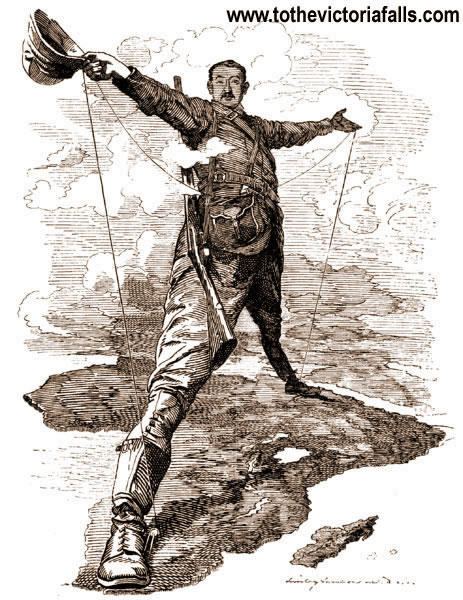
'The Rhodes Colossus' - Rhodes as satirised in Punch magazine in 1892 after announcing his plan to extend an electrical telegraph line from Cape Town to Cairo.
Rhodes Cuts a Deal
Having initially frustrated the plans of Exploring Company, Rhodes now put forward his own plans for a railway into the interior.
"During the negotiations for the Charter in the middle of 1889 Rhodes’s group pledged to spend half a million pounds on constructing a railway through Bechuanaland. It was partly on the strength of this pledge that the Charter was granted."
Faced with finding the finances for the project, Rhodes illustrated his gift for cutting a deal when he persuaded John Gordon Sprigg, the Cape Colony Prime Minister, not only to loan the Chartered Company the necessary finances, but to also oversee the construction and, when complete, the right to buy the line at cost price.
"Rhodes’ plan was to offload the financial responsibility for the railway on to the Cape. In October 1889 Rhodes put out feelers to Sprigg, requesting the Cape government’s co-operation in the Company’s Bechuanaland railway project. The Cape Premier was compliant: he was prepared to afford Rhodes ‘facilities for the economical construction of the line, in anticipation of the intention of the [Cape] Government to purchase the line upon its completion.’" (Maylam, 1977)
The Chartered Company, in return for constructing the railway to Vryburg, was to receive a land grant of 6,000 square miles (9,656 km²) of territory in Bechuanaland and a further 6,000 square miles should it be continued to Mafeking - a share of which appeased the investors of the Exploring Company for their part in the plans.
Into the Interior
Rhodes had returned to Africa in August 1889, and on the same day as receiving notification of the Charter, at the end of October, signed the contracts on behalf of the British South Africa Company to extend the railway 127 miles (202 km) north from Kimberley to Vryburg. Sir Charles Metcalfe had already completed the provisional surveying work and the construction engineers were at work within days of the contract being signed.
"[The] railway was put in hand in 1889 from Kimberley to British Bechuanaland. This 127-mile [202 km] line, which was constructed by the British South Africa Company, crossed the Vaal River at Fourteen Streams and ran on the then Cape Colony border to Vryburg (then in British Bechuanaland), which was reached in December 1890." (Croxton, 1982)
The railway was built departmentally by the Cape Government, with construction supervised by the Cape Commissioner of Public Works, Mr (later Sir) James Sivewright and the General Manager of the Cape Government Railways, Mr C B Elliott (Maylam, 1977). A section of the line was completed under the supervision of George Pauling’s cousin, Mr Harold William Pauling (1864-1904).
The extension to Vryburg, 774 miles (1,245 km) from Cape Town, was completed and officially opened on 1st December 1890 with the line immediately handed over to the Cape Government Railway for operation.
"Vryburg entered upon a new era when the railway was officially declared open. The growth of the town itself, which was greatly Increased during the past six months, is now setting in with renewed vigour, and the white population, which a year ago was 200, and is now 500, is expected to reach 1,000 in a month." (The Hobart Mercury, December 1890)
Prime Mover
Rhodes became Prime Minister of the British Cape Colony on 17th July 1890, at the age of only 37, and championed the railway as the essential means by which to achieve his political and business ambitions.
"In a speech... in 1891 Rhodes himself admitted, ‘If there was anything that induced me to take the position of Prime Minister, it was the fact that I was resolved in my mind that we should extend to the Zambesi.’ Rhodes found himself in the extraordinary dual position of being the head of a parliamentary government and the managing director of a Chartered Company. His power of directing South African events was now immeasurable." (Maylam, 1977)
He is recorded as saying: “Pure philanthropy is all very well in its way, but philanthropy plus five percent is a good deal better” (Hensman, 1901).
A Meeting with Mr Rhodes
In 1891 Rhodes invited George Pauling to Cape Town to discuss plans to extend the railway from Vryburg to Mafeking (now Mahikeng).
"While I was about to leave Africa in 1891, and indeed after I had made arrangements to go home by the east coast route, I was summoned by telegram from Barberton to Cape Town, where Mr Rhodes wished to see me about the extension of the railway from Vryburg to Mafeking. Vryburg is the capital of Bechuanaland, and had for some little time been the terminus of the line northward from Cape Town.
"I accordingly abandoned my plans, and accompanied by Harry [his brother, Henry], I went to Delagoa Bay, and thence by sea to Cape Town. On our arrival there I saw Mr Rhodes and at his suggestion Harry and I proceeded to Mafeking, travelling by rail to Vryburg and then over the route of the proposed extension by cart to Mafeking. On our return we made a proposal to Mr Rhodes." (Pauling, 1926)
Here plans for the line north stalled for several years as Rhodes turned his attentions to opening a transport link from the east coast into the interior.
"Following discussions with Rhodes on the extension of the railway from Vryburg, he and his brother Harry proceeded to Mafeking and he later submitted a proposal on which he was requested by Rhodes to proceed to London for discussions with the directors. However, financial troubles delayed commencement of the work for a time. Meantime, in 1892, he was invited by Mr Beit to build 50 miles [80.5 km] of 2 ft. gauge [60.9 cm] line from Fontesvilla, 30 miles [48 km] inland from Beira, towards Rhodesia." (Bolze, 1968)