To The Victoria Falls
Development of the Victoria Falls
The following text is adapted from 'Footsteps Through Time - A History of Travel and Tourism to the Victoria Falls', researched and written by Peter Roberts and published in 2017. Please visit the Zambezi Book Company website for more information.
The Beginnings of Tourism
Within Reach of the World
By 1905 the Falls were being promoted as a global tourism attraction, one publication boldly declaring:
“The average man in the street has hardly yet realised that the Victoria Falls are within reach of anybody having a couple of months to spare... There are two routes to the Falls. One, the most direct and quickest, is via Cape Town and the Rhodesia Railways. The other is via Beira and the Mashonaland Railways. The first-class fares to Bulawayo are much the same by either, being a trifle over £40. The second route makes the railway journey shorter, and both methods of getting to Salisbury and Bulawayo have equal claims to recognition. The tourist can leave London on any Saturday, join the Union-Castle Company’s mail steamer at Southampton, and reach Cape Town in a little over 16 days, and be in Bulawayo on the 21st day out from England. A train-de-luxe carrying first and second class passengers and the oversea mails leaves Cape Town every Wednesday, reaching Bulawayo on the following Saturday morning, the journey taking a little under three days. In addition to the train-de-luxe, there is an ordinary through service twice a week between Cape Town and Bulawayo.” (South Africa Handbook No.32, 1905)
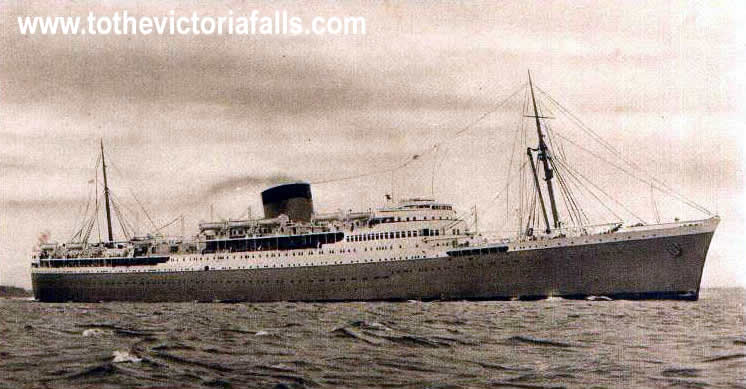
The Union Castle Mail Steamship Company, official mail carrier from the United Kingdom to the Cape Colony in South Africa, was intrinsically linked with the early development of the Rhodesias. The Company sailed from Southampton every Saturday, taking 17 days to reach the Cape. From there it took three days by train to Bulawayo and a further 22 hours to reach the Falls. It was not uncommon for passengers to travel this great distance only to stay a few nights at the Falls Hotel and then start their return journey. There were no catering services on the trains, and passengers were advised to bring their own blankets and food for the trip.
The Union Castle Royal Mail Steamer 'The Capetown Castle'
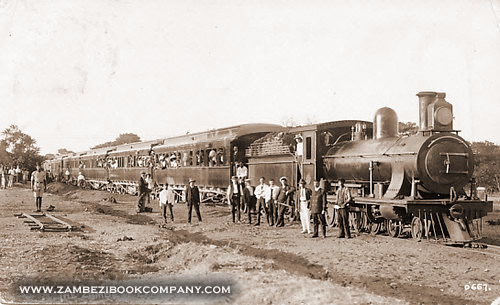
The Zambezi Express
By June 1905 three passenger trains a week were running to and from Bulawayo. Also featuring on the timetable was the Zambezi Express - a special weekly service from Kimberley to the Victoria Falls, which completed the final 450 kilometres from Bulawayo in under 18 hours, and fully equipped with bedding services and dining car. Passengers received an ‘Annotated Time Table of the Zambezi Express on the Rhodesia Railways’, which gave details of the times at the stops along the route in both directions, and interesting information and photographs on the places passed. A connecting train ran from Cape Town. Croxton recorded the following extract from the Cape Government Railways timetable of September 1906:
“A First Class Saloon for Victoria Falls leaves Cape Town on the 11.30 a.m. train on Tuesdays, and is attached to the Zambezi Express at Kimberley. It reaches Victoria Falls Station at 7.15 a.m. on Saturday. It is luxuriously appointed, and includes showerbath, etc. The distance from Cape Town is 1,642 miles [2,650 km], and the return fare £23 16s 8d. Terms at Victoria Falls Hotel, 21/-a day.”
Of particular note was the dining-saloon, allowing passengers to dine to fine standards en route.
“In contrast to the hampers passengers had to carry on the first excursion service to the falls, those who enjoyed the comforts of the Zambesi Express could lunch in the dining-saloon... The menu consisted of: Tomato Soup; Boiled Kabaljoe with parsley sauce; Haricot Mutton; Roast Ribs of Beef; Assorted Vegetables; Cold York Ham and Roast Beef; Chicken and Tongue; Dressed Salad; Tapioca Pudding; Stewed Fruit; Cheese and Biscuits; and Black Coffee.” (Croxton, 1982)
The Zambezi Express
A group of teachers from the Cape were among the first to take advantage of the Zambezi Express service, travelling to hold their annual conference at the Falls.
“More than one hundred South African teachers held their 1905 conference at the Victoria Falls. A newspaper remarked, ‘they braved the dangers of poverty and malaria, crocodiles, lions and hippos.’ During the run from Bulawayo the Falls they saw a tremendous bush fire; it had been burning for two years and could not be halted. Teachers paid the usual fares to Kimberley; and the round trip to the Falls and back to Kimberley cost twenty guineas a head including full board in the dining-car. Poems, articles and photographs by these learned visitors were collected and published in book form.” (Green, 1968)
Falls on Film
In July 1906 The Optical Lantern and Kinematograph Journal reported that "an expedition will start at the end of July, which has as its object the securing of a comprehensive series of living pictures of the African continent from the Cape to Cairo." The report stated that the films would be taken by the Charles Urban Trading Company, to be shown all over the world "with a view to bringing the resources of the country before the notice of inventors, emigrants and pleasure seekers." (The Optical Lantern and Kinematograph Journal, July 1906, 175).
By March 1907, there were accounts of screenings by the British South Africa Company – including a film called 'The Great Victoria Falls, Zambesi River' which "of fairyland-like beauty, captivated everyone" and was "the topic of conversation in every town where it is shown" (Cinematography and Bioscope Magazine, March 1907, 134, 141 and Convents, Framework, 1988, 108).
Advertisements for the films outlined the positive reviews from the British press and described the expedition as ‘realising Rhodes’ dream’. In July 1907, The Kinematograph and Lantern Weekly published a lengthy full-page review, lavishing praise on the film and, when describing a scene of the Eastern Falls, stated that ‘it is without exception the finest kinematograph picture we have ever seen’. It praised the work of the ‘expert kinematographer’ – the viewer feels as if they are ‘standing at the water’s edge rather than merely looking at a pictorial reproduction’ – and presented the film as an ‘admirable example of the unique powers of the kinematograph, in the recreation of pleasurable sensations’. The review further emphasised the power of film as a medium – ‘words fail to convey an adequate idea of the grandeur of the scenes depicted; indeed we doubt whether the powers of a Ruskin, or a Thomas Hardy, would be equal to the task involved’ – and anticipated that ‘the Charles Urban Company’s latest triumph in kinematograph art… will create a sensation and receive the enthusiastic reception it deserves’ (Kinematograph and Lantern Weekly, 4 July 1907, 126).
The film was the first comprehensive documentation of the Victoria Falls in moving pictures, but there is evidence of earlier film of the Falls. The Livingstone Mail claimed in June 1906 that a cinematograph produced earlier in the year had reached an audience of six million within six months of filming.
External Link: Colonial Films - The Great Victoria Falls, Zambesi River.
Rail Connections
Special connecting train services were the life-blood of the Hotel, bringing cruise liner passengers from the Cape in the south and Beira on the east coast, often in groups of hundreds at a time. First class return trips from the Cape to the Falls took thirteen days - including four days spent at the Falls and three nights at the Hotel.
“Special excursions were organised... each trip lasting thirteen days. Tourists spent four days at the Falls and they were also shown the sights of Bulawayo, the Matopas, Mafeking and Kimberley. First class return fare from Cape Town, including all meals and bedding, was nineteen pounds ten shillings. Tourists were informed that eleven Union Castle mail steamers placed end to end would just reach across the Falls.” (Green, 1968)
Following the formation of the Union of South Africa in 1910, cruise ship tourism to the Cape, and travel into the interior by train, was heavily promoted, with the Victoria Falls the jewel in Africa’s crown. A 1911 South African Railway pamphlet promoted the Falls as “the most beautiful gem of the earth’s scenery” (Green, 1968). In 1913 there were five special excursion trains from the Cape alone.
Union Castle Promotional Poster
Difficult Customers
One early railway traveller to the Falls was Mrs Getcliffe, of Cheshire, England, who travelled on a special train service from Johannesburg and wrote of her travels in the ‘Macclesfield Courier & Herald’ in 1910. The train carried 100 passengers, 20 staff, two dining cars, a food supply wagon and five tons of ice.
“There were three passengers in each compartment, the remaining berth being used for our luggage. The seats were very comfortable, being fitted with springs, and at night they were turned into beds with pillows, sheets, etc. Each compartment had a lavatory basin and a looking glass so that passengers could either dress in their compartments or, if they so preferred, in the bathrooms.”
Mrs Getcliffe and her companion stayed at the Hotel and recorded:
“We were not charmed with the accommodation or the service, but when we felt inclined to complain we reflected that all the food had to be brought from Cape Town or Beira, and that there are no shops nearer than Bulawayo, which is a 20 hours journey by rail.”
Crossing the Bridge to visit the town of Livingstone Mrs Getcliffe appears to have again been unimpressed:
“One day we visited the town of Livingstone, a few miles north of the Falls. It is difficult to imagine how people live there in the great heat, and what they do for a living. There are few shops... about four blocks of houses and a club. To be Chief Magistrate and His Majesty’s Representative in such a place is certainly paying the penalty of greatness.” (Rhodesia Railways Magazine, March 1962)