To The Victoria Falls
Development of the Victoria Falls
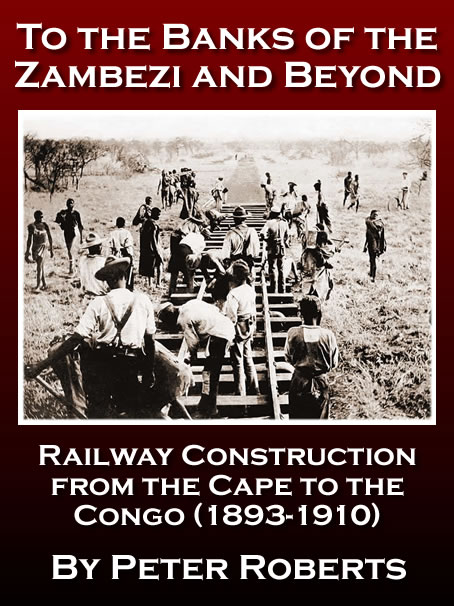
The following text is adapted from 'To The Banks of the Zambezi and Beyond - Railway Construction from the Cape to the Congo (1893-1910)', researched and written by Peter Roberts and first published in 2021. Please visit the Zambezi Book Company website for more information.
Through the Wilds to Hwange
In April 1903 a second contract was agreed for the construction of a further 46 miles (74 km) of railway terminating near the Wankie coal mines. The cost for this contract was £2,872 per mile, no doubt due to the much more difficult terrain on this section.
Reports record Pauling employing some 2,500 labours on the line. Reporting to Sir Charles Metcalfe on progress of the line was Mr Charles Beresford-Fox, Assistant Resident Engineer for the Railway Company (and nephew of Sir Douglas Fox). Mr Beresford-Fox would be involved with the development of the line to the Falls and preparations for the Bridge.
Mr W A Sicklen was employed by Pauling on the railway construction from 1898 and worked on the line north for nearly ten years until 1907. In mid-1921 Mr Sicklen recorded his memories of railway building in a newspaper article widely syndicated at the time.
"I may here say the eight-hour day didn’t count, neither did the go-slow policy. It was a case of work like hell, very often under the great hardships which are incidental in opening up and pioneering a new country such as this... The sleepers, which are of steel, being carried from the material train and laid on the already prepared foundation. The rails were then carried out and laid on the sleepers, then came along the linking-in gang, who turned the rails into the lugs of the sleepers. The fishplates were then put on, and two of the four bolts tightened up, and the train then moved ahead to the end of the rails.
"I will now try and give a short description of every-day work. Up at daylight, a cup of tea, plate-laying train ready for railhead with material; cooks and workmen all aboard; for breakfast 30 minutes, dinner 45; back at camp at 7 or 7:30 in the evening, and a hot tea of meat, potatoes and vegetables; smoke and turn in." (The Blue Mountain Echo, May 1921)

Railway construction
Mr Clark Stakes His Claim
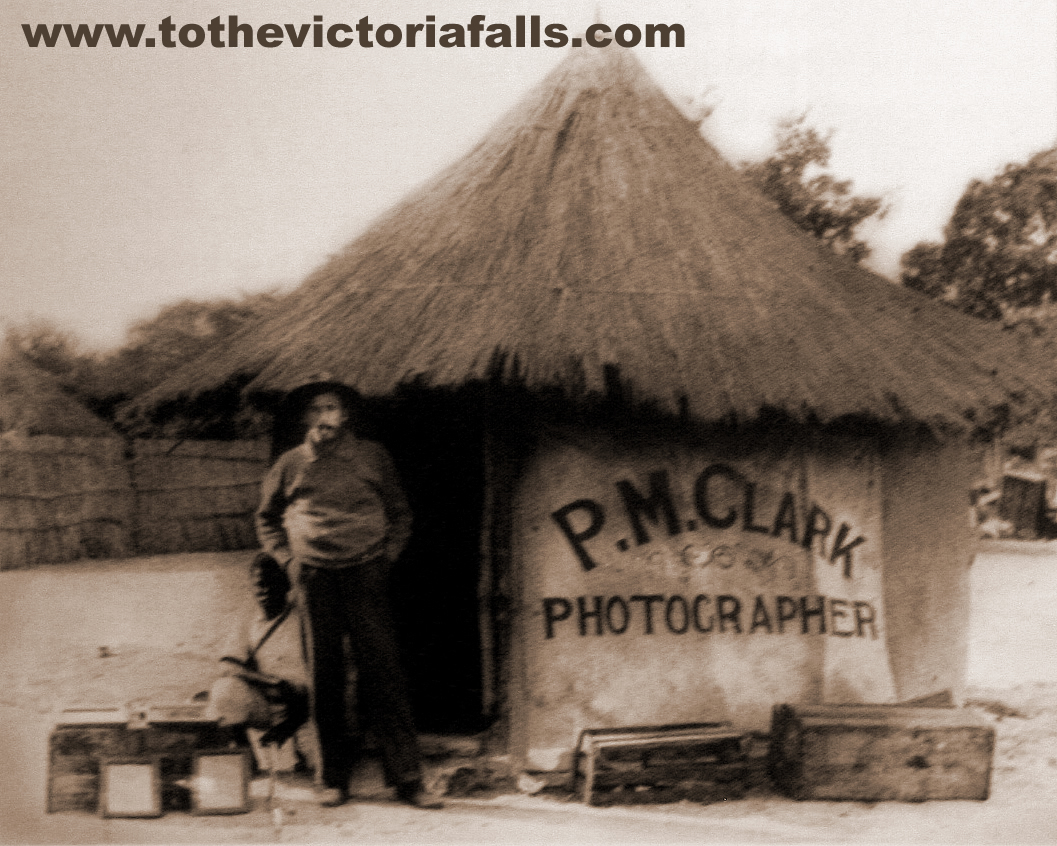
In May 1903 Percy Missen Clark arrived at the Victoria Falls from Bulawayo with the intention of starting a photography business.
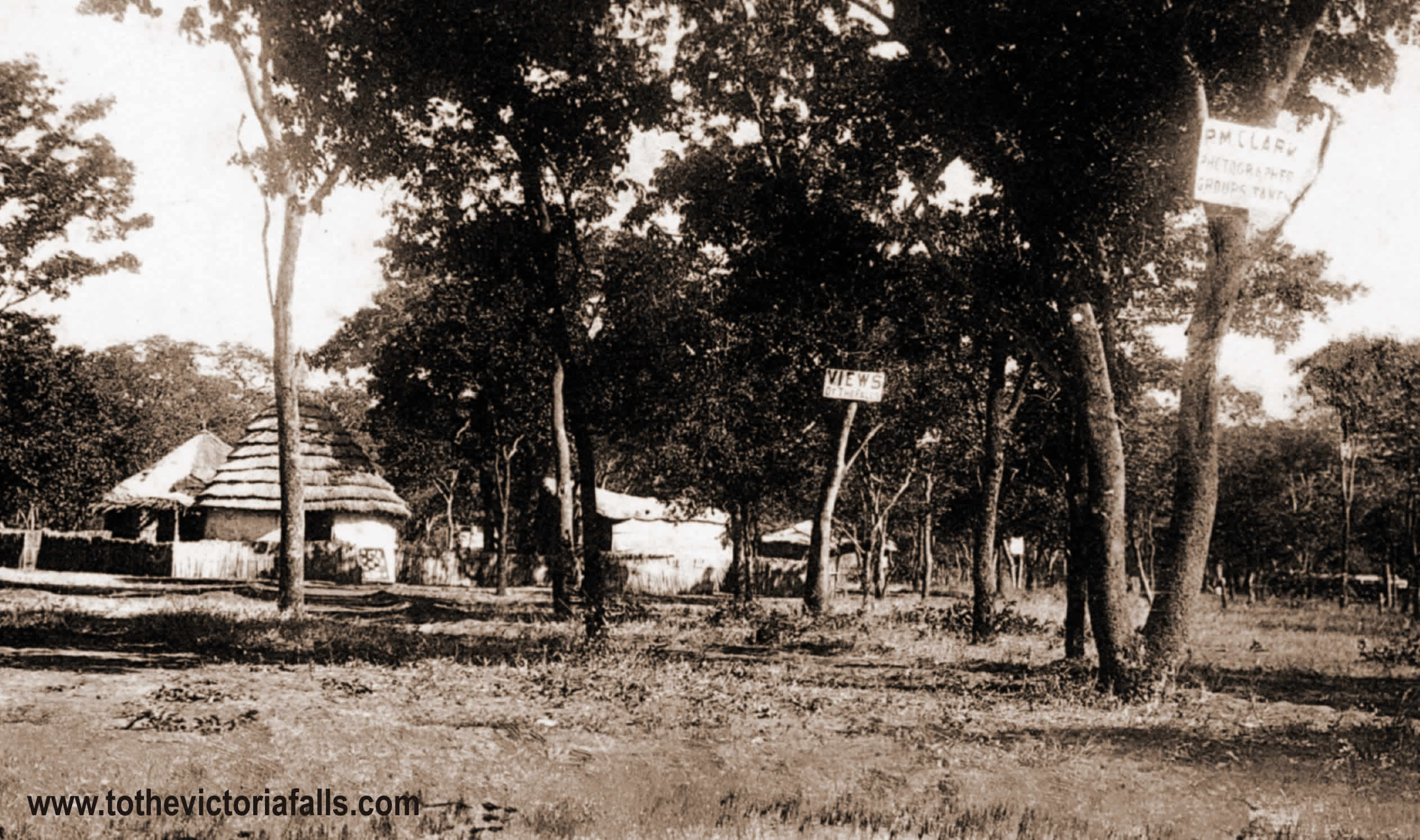
"I made my headquarters at the Old Drift for the time being, but my intention was to settle at Victoria Falls as soon as the railway was completed, for I believed that there would be great opportunities for those who got in early at the railhead. At the end of the year I engaged a man to build a hut for me near the spot where the railway station would be pitched, and where the hotel would be built, but I had no mind to cross the river until the railway did come up."
Percy Clark
A chemist by profession, Clark successfully established himself on the south bank as a photographer, selling many postcards and a popular portfolio of photographs of the Falls entitled a ‘Souvenir of the Victoria Falls,’ of which there were several variations produced over the years. He also developed his own guidebook to the Falls and traded in a variety of African curios and souvenirs.
"While I lived at the Old Drift I spent a lot of my time at the Victoria Falls taking photographs, and I got together quite a good collection. I would camp out for a couple of days at a time in the hut... When that was completed I lived in it, but for most of the time I was over on the other side at the Old Drift. I liked the older haunts, and the old crowd." (Clark, 1936)
The Huts
Clark was made Fellow of the Royal Geological Society for helping Henry Balfour, on the visit of the British Association, find stone-age axe heads close to the Victoria Falls. He exhibited his photographs of the Falls at the Royal Geographical Society and was elected Associate of the Royal Photographic Society in 1925. ‘The Autobiography of an Old Drifter: The Life Story of Percy M Clark of Victoria Falls’ was published in 1936. He lived in the Falls area until his death in 1937 - but is buried, however, in Livingstone Cemetery. Clark’s son, Victor, himself a skilled photographer, took over the family business and continued it for many years.
Hwange Reached
The advancing rails reached Hwange in October 1903. Such was the demand for coal that the first train loads were transported south soon after with the line still under construction conditions. The line was officially opened for traffic on 1st December with onward passengers and mail transferred to the Zeederberg coach service for the remaining 68 miles (109.5 km) to the Victoria Falls.
The final contract, for the third section of line from Wankie to the Victoria Falls, was signed in December 1903, at an agreed price of £2,350 per single mile with a bonus of £7,500 for Pauling and his men in the event of the rails being suitable for the passage of trains by 1st April 1904.
Sir Charles Metcalfe reported to the press that the Falls would be reached by the following April. Planning for a grand hotel at the Falls, to accommodate one hundred guests, were apparently well advanced.
"It is estimated by Sir Charles Metcalfe that by April next the Falls will be reached, and a few weeks or months later passengers will be able to travel by Pullman car to a spot that twenty years ago was hardly known. The few people who have yet been able to visit these marvellous Falls agree in describing them as one of the greatest wonders of the world and it is not surprising to learn that the promoters of the railway are making the usual arrangements for exploiting this great natural wonder.
"A large hotel is to be built at a convenient distance, capable of accommodating one hundred guests, and on either side of the river land is to be reserved for a great park. It is obvious that even people who go to look at waterfalls must eat and drink, and to that extent some sort of hotel is necessary, but there may be a danger of overdoing the comforts of civilisation. Already in Switzerland many of the most beautiful places have been partly spoilt by the erection of giant hotels that are necessarily out of character with the general scene. Sir Charles Metcalfe appears however, to be conscious of this danger, and it is to be hoped that he will insist that both the railway and the hotel are kept sufficient distance from the Falls to prevent the vulgarisation of the greatest waterfall in the world." (The Auckland Star, December 1903)
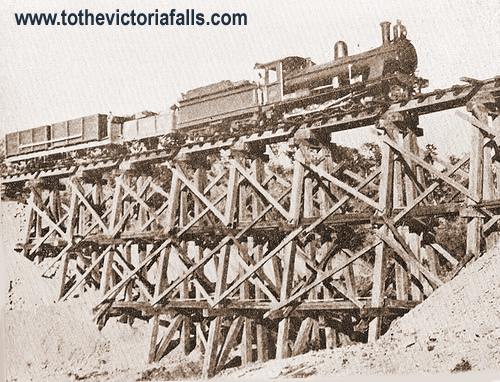
Temporary timber trestle bridge over the Matetsi on the Bulawayo to Victoria Falls line
At the Victoria Falls
Construction of the final 68 mile (109.5 km) section of the railway line to Victoria Falls began on 21st September 1903, again financed by Rhodesia Railways Ltd, who were also responsible for the funding of the Bridge and the continuation of the line into North-Western Rhodesia.
The first 47 miles (75.5 km) of line from Hwange was particularly challenging for Pauling and his railway construction men, and included very heavy work through difficult country covered in dense bush and supporting a full complement of Africa’s ‘Big Five.’
"The sixty-eight miles [109.5 km] of line from Wankie to Victoria Falls included forty-seven miles [75.6 km] of very heavy work through difficult country and the line was constructed to the stiff grade of 1 in 50, uncompensated, with 7-chain curves, equivalent to 1 in 37 over the curves. Two severe banks were encountered, one from Deka siding up the Katuna valley and the other from Matetsi to a point later named Fuller. These climbs were both on maximum grade against northbound trains and the Katuna bank was aggravated by a horseshoe bend, which was to cause endless trouble to enginemen over the years to come. Two major river crossings were involved, one over the Deka, nine miles [14.5 km] from Wankie, with a water tank sited not far away to top up supplies before tackling the Katuna bank, and the other was the Matetsi, about half way to Victoria Falls. For the latter a temporary trestle bridge, 260 ft. [79.2 m] long and 43 ft. [13.1 m] high, was built to carry the line forward. It was probably the biggest trestle bridge to be built by Paulings and was later replaced by a steel girder structure." (Croxton, 1982)
The trestle bridge at the Matetsi, 260 feet (79 m) long and 43 feet (13.1 m) high, was the largest bridge of this type on the line and was supported by substantial rock ballasting.
The construction company were also responsible for erecting semi-permanent masonry and steelwork bridges, built to basic requirements but suitable for passenger traffic, before handing the line over to the Railway Company for operation. Permanent bridges were erected along the line in the years that followed.
Pauling subcontracted the work of preparing the earthworks ahead of the construction gangs to experienced Italian engineer Giacomo D’Alberto, who had worked on mining and railway contracts in southern Africa since the early 1880s (Museo dell’emigrante, Roasio, 2021). The skilled work of constructing the supporting stonework piers and abutments for the temporary bridges was also undertaken by a group of specialist Italian stone-masons.
The line to the Victoria Falls was completed on 24th April 1904, several weeks after the target date of 1st April - for once Pauling had been unable to deliver to the target date and perhaps a reflection of the tough territory traversed. As the last rails were laid the supporting construction train following immediately behind slowly rolled to a stop within sight of the rising spray of the Falls.
"The operation of completing the linking in of the rails to Victoria Falls station by the contractors, Messrs Pauling & Co, which took place on Monday, April 24th, formed an interesting scene. On that day Mr Harold Pauling, Dr W Pauling, Miss Blanche Pauling, Miss Veale and Mr Hicks, agent in charge of the works, arrived at the end of the rails at Falls Station, which is a mile and a quarter from the commencement of the Bridge.
"The plate-laying gang started on Monday morning, and the rails were laid to the station by one o’clock. Over the last half mile Miss Pauling and Miss Veale drove the engine through the station yard to the end. The first-named lady is entitled to call herself a railway pioneer, as she was on the engine No.289 of the first train that steamed into Bulawayo in October 1897. Altogether there were present to witness the engine steaming into the Falls Station, inclusive of the contractors employees, between 30 and 40 white men, many of whom had come down from the other side of the river...
"The contractors are distinctly deserving of congratulation, as the commencement of the line north from Wankie was only begun last September and the construction included 47 miles [75.6 km] of very heavy work. On this section, also, the contractor build a bridge [at Matetsi] 260 ft. [79.2 m] long and 43 ft. [13.1 m] high, which is the biggest temporary trestle bridge to carry traffic ever erected in South Africa.
"Owing to an alteration of the plans the level of the bridge will be 20 ft. [6 m] lower than was originally intended, and this necessitates a rock-cutting to the approach of the bridge which remains to be done, but the rails will be within a quarter of a mile of the river gorge by the end of this week. The distance from Wankie to the Falls Station is 69 miles [111 km], making a total from Bulawayo of 280 miles [450.6 km].
"At present there is no accommodation for travellers nearer than Mr F J Clarke’s store at Livingstone, which is fully five miles [8 km] away and on the north bank of the river. The Rhodesia Railways are, however, about to erect temporary buildings for the accommodation of travellers. Messrs Pauling will start public traffic on the 10th inst by running, as an experiment, two trains weekly each way on the Wankie-Falls section. North of the river there are two survey parties working for Messrs Pauling under Mr Mansergh. One of these parties is between the Falls and Kalomo and the other is on its way to Kafue." (Bulawayo Chronicle, May 1904a)
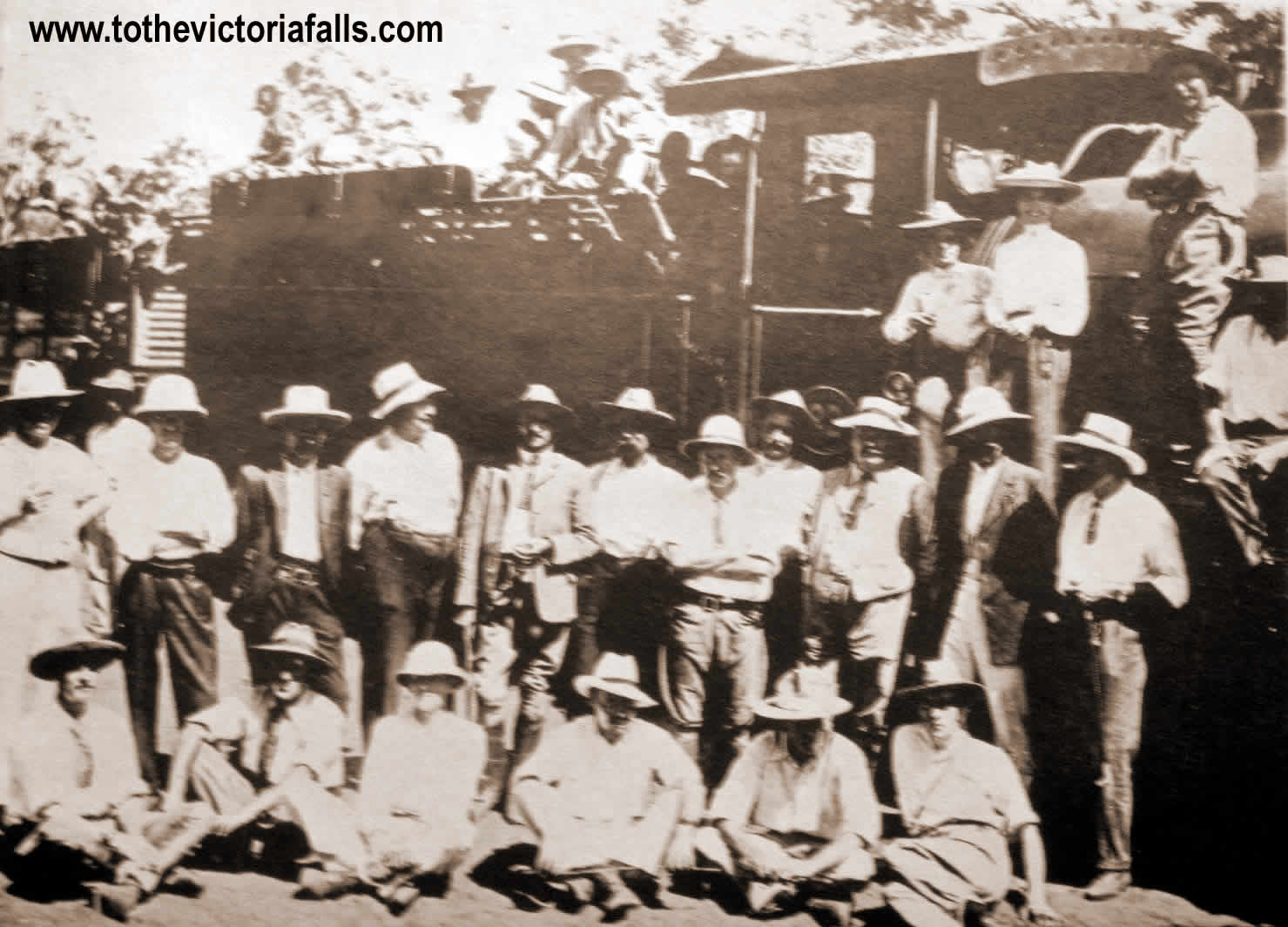
Harold Pauling was in charge of the work with his daughter, Blanche, acting as engine-driver on the 7th Class engine, No.22, for the last push to the end of the rails.
"The train was hauled by R.R. 7th Class No.22 and for the last lap was driven by Harold Pauling’s daughter, Blanche, with the locomotive flying a Union Jack and bearing the board below the headlamp reading ‘We’ve got a long way to go.’ This referred to Cairo, as the target of Cecil Rhodes was still very present in men’s minds. Blanche Pauling had already travelled on the first engine to reach Bulawayo in 1897, so she could well claim to be a pioneer engine driver. In wide-brimmed felt hat, high collared white blouse and dark skirt down to her ankles, she made an unusual figure on the footplate. As soon as the last sleeper was laid and the train came to rest, celebrations began, with native sports, mock battles by the tribesmen, and a feast for all the staff, white and black, engaged on the work." (Croxton, 1982)
In his autobiography Percy Clark proudly tells of his success in selling photographs of the arrival of the first train to all the engineers, contractors and railway staff and "did a roaring trade in prints at five shillings a time" (Clark, 1936).
A temporary station building was quickly improvised, with Pauling operating two trains a week between Hwange and Victoria Falls from 10th May 1904, before the line was handed over to the Railway Company for official opening on 20th June 1904 (a permanent station building was erected and opened in the first half of 1905, with Mr John Fairlamb as Station Master).
A Post Office was established within the temporary building and a regular mail service operated from 1st July 1904 with Mr Daniel O’Leary as postmaster (the earliest known date-stamp of ‘Victoria Falls, S Rhodesia’ being 17th July 1904).
The distance from Cape Town was 1,641 miles (2,641 km). Only twenty years before it took over six months of trekking with oxen to get to the Falls - now the journey was measured in days. The trains took 22 hours on the Bulawayo to Victoria Falls journey and 24 hours on the return.
In advertisements it was stressed that passengers needed to provide their own blankets and food for their journey as there were no dining carriages and no intermediate stations where refreshments could be obtained.
Mr Pierre Gavuzzi, Manager of the Bulawayo Grand Hotel, provided hampers for the adventurous train travellers. In late May 1904 Mr Gavuzzi would have been arranging his own hamper for the journey north, travelling by train with several truckloads of building materials destined for the construction of a modern hotel overlooking the rising spray of the Falls, and to which he had been appointed as general manager by his employers.
The first train to arrive at Victoria Falls on the 24 April 1904, RR 7th Class No 22.
Group includes Harold Pauling (standing 3rd from right) and his daughter Blanche (in white blouse).