To The Victoria Falls
To the Congo
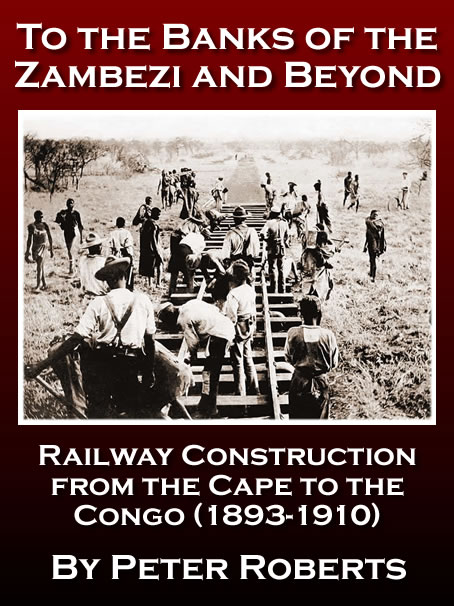
The following text is adapted from 'To The Banks of the Zambezi and Beyond - Railway Construction from the Cape to the Congo (1893-1910)', researched and written by Peter Roberts and first published in 2021. Please visit the Zambezi Book Company website for more information.
The Railhead Advances
With the successful installation of the Blondin transportation of construction materials to the northern bank could begin, not only for the erection of the Bridge but also the continuation of the northern extension of the railway 94 miles (151 km) to Kalomo.
A report in the Bulawayo Chronicle, dated 21st October, detailed progress.
"On the 25th September the first rail on the north bank was laid by Mr A L Lawley (Pauling and Co’s chief representative), assisted by Messrs C V Buchan and W H Beavon, and before nightfall quite a respectable show of sidings had sprung into existence." (Bulawayo Chronicle, October 1904b)
Pauling and Company quickly established a base of operation on the north bank.
"Pauling & Co established a depot with a small loco shed, coaling and watering facilities, and a permanent way store on the north side of the Maramba River just south of what is now Livingstone. It was the scene of much activity... and adjacent to the locomotive depot the Paulings built quarters for their staff and even had their own guest house which was used by George Pauling and his friends when on tour in what was, at the time, Northern Rhodesia." (Rhodesia Railways Magazine, July 1967)
To move heavy materials and assist with the construction of the Bridge a light shunting engine was required on the northern bank. A small 19-ton locomotive, named the Jack Tar, was dismantled and transported in parts over the gorge by means of the Blondin cableway.
The boiler and lighter parts were sent over first. The remaining section, the main body frame and cylinders, weighed 12 tons and had to be transported in one piece. Varian described how the cable sagged under this load and dangled over the gulf with a fourteen metre drop in the cable. There it hung for three hours as the engine struggled to cope with the weight, until by boosting the power of the electrical plant and by other means of assistance the carrier slowly reached the other side. The driver, Mr Chalmers, sitting on his little seat with the daunting drop below him is said to have calmly smoked throughout the crossing.
Once on the north bank the engine was re-assembled by engineer Mr Teddy Layton. The Jack Tar claimed two notable ‘firsts’ during the construction of the Bridge. Its first claim to fame was to pull the first train north of the Zambezi, over a short track built in a day. It later became the first locomotive engine to cross the Bridge, pulling two trucks from the northern bank across the temporary deck and rails back to the southern side.
"The first engine was brought over in sections, and re-erected by Mr E C Layton, of the Rhodesia Railways, in the creditably short period of 77 working hours. On the 7th [October] a mile of rails being laid, steam was got up and the first trip was made by the engine, driven by Mrs Lawley, with her on the engine being Messrs Layton (R.R.), Beavon (Pauling and Co.) and Powell (Bridge Co.). Afterwards the usual ceremony of ‘christening the engine,’ the engine was gone through, and it was then abandoned to its useful work of carrying the iron road farther north. The telegraph lines have been erected to the Depot (5½ miles [8.8 km] out), and the rails are expected to reach these shortly, construction being temporarily impeded by the necessity for a 100 feet [30.5 m] bridge over the Maramba River." (Bulawayo Chronicle, October 1904b)
Mr P St G Mansergh was again responsible for the surveying of the line (Croxton, 1982). Mr Townsend remained as Chief Resident Engineer for the Railway Company, with headquarters at Bulawayo (Varian, 1953). Varian replaced Beresford-Fox as Resident Engineer overseeing the ongoing works for the Railway Company, assisted by Mr Everard as Assistant Engineer. Varian also had specific responsibility, as Resident Engineer, for the construction of the Kafue bridge.
Varian established his camp on the sand ridge which soon after became the new town of Livingstone.
"After a month on the bridge works, I was detailed as District Engineer to go forward with the construction work that had been started to the north. I accordingly made my camp near the spot chosen by the contractors, Pauling & Co, for their depot. The rails had not yet reached the site, which was on the flat ground surrounding the present Livingstone Station. I camped on the hill just beyond the present township of Livingstone. Several months later, when the Government Surveyor came to lay out the township, I shifted down to the flat near the contractors’ depot."
Harold Pauling had died soon after the railway had reached Victoria Falls, and Mr Arthur L Lawley took charge of the railway construction from Livingstone for the contracting company. Lawley was assisted by a Mr Hicks and Mr C V Buchan, who left the construction as the line neared Kalomo (Croxton, 1982).
"The progress of the construction of the 94 miles [151 km] to Kalomo was naturally slow, as all the materials after crossing the gorge either by Blondin or in light loads across the temporary line on the unfinished bridge, had then to be off-loaded, sorted, and re-loaded for transport ahead. This work, together with the re-erection of the engines and rolling stock, was done at Pauling’s depot at Maramba, five miles [8 km] north of the river; so there was considerable delay, principally at the river-crossing itself, where transport could only be utilised when it did not interfere with work on the bridge. In spite of this, the line to Kalomo was laid before the first full train crossed over the permanent bridge." (Varian 1953)
Kalomo Reached
The line north required an estimated 200 tons of rails and associated material to be transported across the gorge each day in order to advance the railway projected daily target of one mile (1.6 km). Work started in early 1905 and progressed simultaneously with the Bridge construction, with 50 miles (80 km) of the 94 mile (151 km) line to Kalomo completed before the Bridge was even open for construction traffic, all the rail materials having been transported across the gorge via the Blondin.
The terrain was relatively easy country for the track-laying gangs, the only obstacle being the Kalomo River which needed a bridge with three 100 foot (30.5 m) spans.
On the final stages to Kalomo Pauling’s men laid an incredible nine and a quarter kilometres of this line - in the area later known as Pemba - within a single working day (totalling eleven hours of uninterrupted track-laying).
"By the time the bridge was open to traffic, some 50 miles [80 km] of line beyond had been laid by Pauling and his men, and Kalomo, 94 miles [151 km] from the Victoria Falls, was reached in May 1905. Pauling’s workers had laid five and three quarter miles [9.25 km] of this line - in the Pemba area - in the then staggering time of eleven hours. This had arisen as the result of a conversation between Sir Charles Metcalfe, Chief Engineer on the line, and a visiting French engineer [no doubt Imbault], who had asked what length of rails could be laid in one day.
"‘Guess,’ said Sir Charles. The Frenchman hazarded half a mile. Sir Charles spoke to the men and they set to; a quarter of a mile was laid in just 20 minutes. Spurred on by this, they continued the race for 11 hours." (White, 1973)
Now an experienced hand on the railway construction, Mr W Sickert recorded the last dash to Kalomo:
"However, it was along through this country we did our greatest day’s work, and which yet stands as a world’s record for plate-laying. A temporary siding was laid which was filled with trucks of material, rails, sleepers, fishplates, and bolts. Between 600 and 700 natives and 14 white men were employed on this record-breaking day. Everything being well organised, a start was made at break of day, the first mile being actually laid and the train passed over in one hour and twenty minutes. Sounds incredible, doesn’t it? Yet it is true. Immediately the last truck was empty the engine ran back with her empties, un-coupled and hooked up to her next load. Another engine then picked up the empties and ran back to another siding, shunted them, and brought up more material; and so the game went on until 4.40 p.m, when no more material was available. Five and three-quarter miles [9.25 km] were laid that day, and it is all the more remarkable when I say that no track-laying machine was used.
"There were 14 rail-carrying gangs alone, the natives who entered into the spirit of the thing, positively running with the rails on their shoulders from the train to where they laid them on the sleepers ready for linking in, as they did with the sleepers from the train ahead of the linking-in gangs, of which there were four. The rails were 33 ft. [10 m] in length, and weighed 60 lb. [27 kg] to the yard. The writer can fancy railway men who read this calling him an unmitigated liar, nevertheless it is true. The news was known in London next day by cable, and the feat is doubtless in Messrs Paulings’ records still. The two foreman, Partridge and Loggie, each received £10 bonus and a gold medal, the other white employees each receiving a fiver bonus." (The Blue Mountain Echo, May 1921)
The rails reached Kalomo, 1,733 miles (2,789 km) from Cape Town, in May and the line officially opened to traffic in July 1905.
"The rails reached Kalomo, the end of the first contract of 94 miles [151 km] from the Falls, in July 1905. Then there was a hiatus. It seemed that we should stop there, on account of a financial hitch, and we were all given provisional notice, but it did not last for long. With the completion of the first contract, a new contract had been arranged and out next objective, the recently-developed mine at Broken Hill." (Varian, 1953)
A memorandum from the office of the Chief Resident Engineer, Mr Townsend, on 31st August, 1905 noted that there was as yet no water available to trains between the 25 mile (40 km) mark and the Kalomo River, a distance of 65 miles (104.6 km), and that as a result each train would carry an auxiliary water tank of 2,500 gallons (Rhodesia Railways Correspondence, August 1905).
Kalomo itself was still little more than a collection of Police postings, although quickly grew with its position as capital for the Company’s Administration.
"Kalomo consisted of some half-dozen houses and offices, two stores and a branch of the Standard Bank, barracks for Native Police, some half-dozen officials, and two or three of the Rhodesian Mounted Police. About 60 miles [96.5 km] north of the falls the country changes, and one could get good sport on Sunday with the rifle among the oribi, a small antelope, weighing perhaps 25 to 30 lbs. [11-13.5 kg] when dressed, and good eating." (The Blue Mountain Echo, May 1921)
|
References
Bulawayo Chronicle (October 1904b) Victoria Falls Notes. 29th October, 1904.
Croxton, A. (1982) Railways of Zimbabwe.
Rhodesia Railways Magazine (July 1967) There was only one Jack Tar. Vol.16, No.2, p.19.
The Blue Mountain Echo (May 1921) Cape-Cairo Railway - First Engine over the Zambesi. 6th May 1921.
Varian, H F (1953) Some African Milestones Wheatley : George Ronald. (Reprinted 1973 Books of Rhodesia).
White, B. (1973) The Trailmakers, The Story of Rhodesia Railways. Supplement to Illustrated Life, Rhodesia, 31st May 1973.
Further Reading
Roberts, P. (2021) To The Banks of the Zambezi and Beyond Railway Construction from the Cape to the Congo (1893-1910). Zambezi Book Company.

|
|
Search www.tothevictoriafalls.com:
|
'To The Victoria Falls' aims to bring you the wonder of the Victoria Falls through a look at its natural and human history.
This website has been developed using information researched from a wide variety of sources, including books, magazines and websites etc too numerous to mention or credit individually, although many key references are identified on our References page. Many of the images contained in this website have been sourced from old photographic postcards and publications and no infringement of copyright is intended. We warmly welcome any donations of photographs or information to this website.
 Website text © Copyright Peter Roberts 2012, All Rights Reserved.
Webpage design by EcoElements Digital Media Solutions
|